54EC Capital Gains Bonds: How to Save Tax on Property Sale
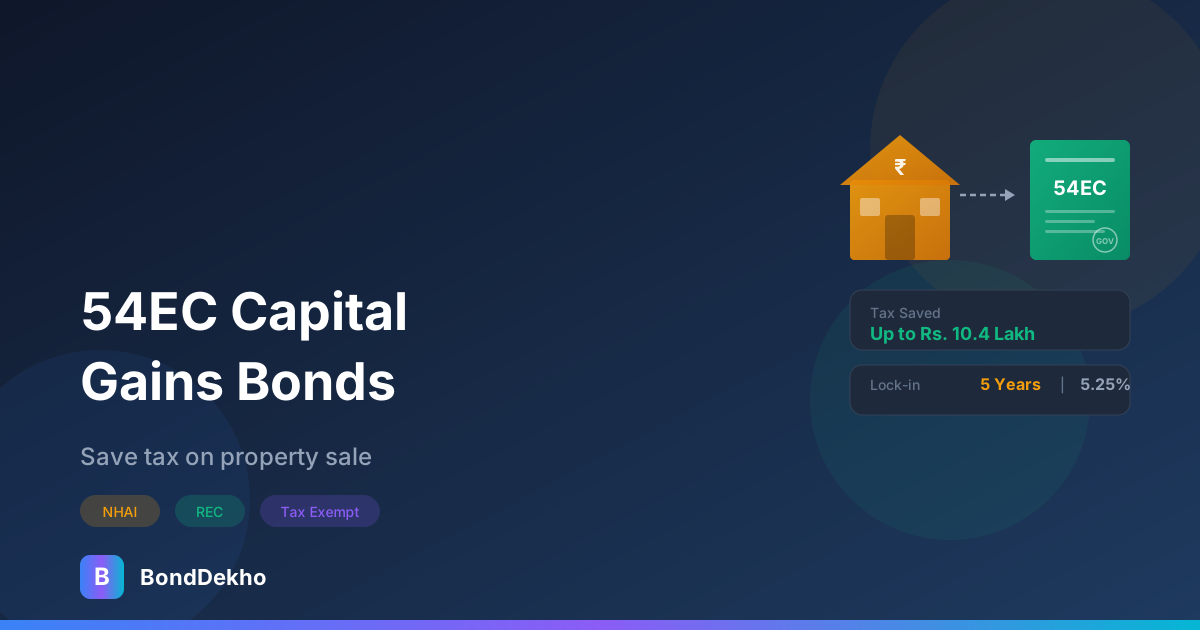
Quick answer: Section 54EC lets you invest long-term capital gains from the sale of land or building into government-backed bonds — issued by NHAI or REC — and pay zero capital gains tax on the invested amount. You must invest within 6 months of the sale, up to a maximum of Rs. 50 lakh per financial year, which shelters up to Rs. 10.40 lakh in capital gains tax (at the 20.8% effective rate including cess). The bonds carry a 5.00–5.25% per annum interest rate (taxable at slab rate), are non-transferable, and lock your capital for 5 years.
You finally sold that ancestral plot of land your family held for 15 years. The buyer paid Rs. 1.5 crore, and after accounting for the original purchase price and indexation, your long-term capital gain comes to Rs. 1 crore. You're relieved—until your Chartered Accountant tells you that you owe roughly Rs. 20.8 lakh in capital gains tax (20% plus 4% cess).
That's a painful number. But there's a legal way to reduce or even eliminate this tax: Section 54EC of the Income Tax Act.
By investing the capital gains into specified bonds—issued by NHAI (National Highways Authority of India) or REC (Rural Electrification Corporation)—you can claim an exemption on the long-term capital gains and keep that Rs. 20+ lakh in your pocket instead of paying it to the government.
This guide covers everything you need to know about 54EC bonds: who's eligible, how much you can invest, how to apply, and whether the trade-off of a low interest rate is worth it.
What Is Section 54EC?
Section 54EC of the Income Tax Act, 1961 provides an exemption from long-term capital gains tax arising from the sale of land or building (or both). The exemption is available when you invest the capital gains amount in specified bonds within 6 months of the sale.
The Core Idea
Instead of paying 20% tax on your long-term capital gains from property, you invest those gains into government-backed bonds. In return:
- You pay zero capital gains tax on the amount invested (up to the annual limit)
- Your money earns a modest but guaranteed interest rate (currently 5.00-5.25% per annum)
- After a 5-year lock-in period, you get your principal back
It's a straightforward trade: accept a lower return on a portion of your capital for 5 years, and save a significant chunk of tax money upfront.
Which Bonds Qualify?
Only bonds specifically notified by the government under Section 54EC are eligible. As of now, two issuers offer these bonds:
| Issuer | Full Name | Bond Type | Government Backing |
|---|---|---|---|
| NHAI | National Highways Authority of India | 54EC Capital Gains Bonds | Central Government entity |
| REC | Rural Electrification Corporation (now REC Limited) | 54EC Capital Gains Bonds | Navratna PSU under Ministry of Power |
Both are AAA-rated, government-backed entities. The bonds from either issuer carry virtually identical terms—the choice between them is largely a matter of availability and personal preference.
Key Features at a Glance
| Feature | Details |
|---|---|
| Lock-in period | 5 years (non-transferable, non-negotiable) |
| Maximum investment | Rs. 50 lakh per financial year |
| Interest rate | 5.00-5.25% per annum (fixed, paid annually) |
| Denomination | Rs. 10,000 per bond (minimum 2 bonds = Rs. 20,000) |
| Maximum bonds | 500 bonds (Rs. 50 lakh) per financial year |
| Listing | Not listed on stock exchanges |
| Transferability | Cannot be transferred, pledged, or used as collateral |
| Interest payment | Annually, on the date of allotment |
| Maturity | Redeemed at par after 5 years |
Who Is Eligible for 54EC Exemption?
Section 54EC has specific eligibility criteria. Not every capital gain qualifies.
Eligible Scenarios
You can claim 54EC exemption when:
- You sell land — Agricultural or non-agricultural, urban or rural
- You sell a building — Residential house, commercial property, factory, warehouse, or any structure
- You sell both land and building together — A house with its plot, for instance
- The asset was held long-term — More than 24 months before the date of sale (as per current rules for immovable property)
Not Eligible
You cannot claim 54EC exemption on capital gains from:
- Sale of stocks or equity mutual funds
- Sale of gold, jewellery, or other movable assets
- Sale of debt mutual funds
- Short-term capital gains on property (held less than 24 months)
- Any asset other than land or building
This is a critical distinction. Section 54EC is exclusively for long-term capital gains on immovable property (land or building). If you've sold shares at a profit and want to save tax, you need different provisions—54EC won't help.
How Much Tax Can You Save with 54EC Bonds?
The tax saving depends on your capital gains amount and how much you invest in 54EC bonds. Here's a calculation table showing potential savings at different levels:
Tax Savings Calculation Table
| Long-Term Capital Gain | 54EC Investment | Taxable LTCG Remaining | Tax Saved (20% + 4% cess) | Tax Still Payable |
|---|---|---|---|---|
| Rs. 20 lakh | Rs. 20 lakh | Rs. 0 | Rs. 4.16 lakh | Rs. 0 |
| Rs. 50 lakh | Rs. 50 lakh | Rs. 0 | Rs. 10.40 lakh | Rs. 0 |
| Rs. 75 lakh | Rs. 50 lakh | Rs. 25 lakh | Rs. 10.40 lakh | Rs. 5.20 lakh |
| Rs. 1 crore | Rs. 50 lakh | Rs. 50 lakh | Rs. 10.40 lakh | Rs. 10.40 lakh |
| Rs. 1.5 crore | Rs. 50 lakh | Rs. 1 crore | Rs. 10.40 lakh | Rs. 20.80 lakh |
| Rs. 2 crore | Rs. 50 lakh | Rs. 1.5 crore | Rs. 10.40 lakh | Rs. 31.20 lakh |
Note: The maximum investment of Rs. 50 lakh per financial year caps the exemption at Rs. 10.40 lakh in tax savings (at 20.8% effective rate including cess). If your gains exceed Rs. 50 lakh, you'll need to pay tax on the remainder—or explore other options like Section 54 or Section 54F.
Detailed Calculation Example
Let's work through a complete example:
Scenario: Mr. Sharma sells a residential plot in Gurgaon.
| Item | Amount |
|---|---|
| Sale price (March 2026) | Rs. 1,50,00,000 |
| Purchase price (April 2010) | Rs. 50,00,000 |
| Cost Inflation Index — 2010-11 | 167 |
| Cost Inflation Index — 2025-26 | 363 (estimated) |
| Indexed cost of acquisition | Rs. 50,00,000 x (363/167) = Rs. 1,08,68,263 |
| Long-term capital gain | Rs. 1,50,00,000 - Rs. 1,08,68,263 = Rs. 41,31,737 |
Without 54EC bonds:
- Tax at 20%: Rs. 8,26,347
- Cess at 4%: Rs. 33,054
- Total tax payable: Rs. 8,59,401
With 54EC bonds (investing Rs. 41,31,737):
- Taxable LTCG: Rs. 0
- Total tax payable: Rs. 0
- Tax saved: Rs. 8,59,401
Mr. Sharma's money is locked for 5 years and earns approximately 5% per annum, but he saves over Rs. 8.5 lakh in taxes. That's a significant benefit, especially since the bonds are government-backed with virtually zero credit risk.
For a deeper understanding of how bond income and capital gains are taxed, read our comprehensive guide on tax planning with bonds.
What Is the Deadline to Invest in 54EC Bonds After Property Sale?
This is one of the most critical rules—and one of the most common mistakes.
The 6-Month Rule
You must invest in 54EC bonds within 6 months from the date of transfer (i.e., the date of sale/registration of the property).
| Sale Date | Deadline to Invest |
|---|---|
| 1 January 2026 | 30 June 2026 |
| 15 March 2026 | 14 September 2026 |
| 1 October 2026 | 31 March 2027 |
| 20 November 2026 | 19 May 2027 |
Important Nuances
- Date of transfer, not date of payment: The clock starts from when the sale deed is registered, not when you receive the full payment
- No extensions: Missing this deadline by even one day means you lose the exemption entirely
- Advance booking: Since 54EC bonds may go out of stock periodically (especially near March-end), apply well before your deadline
- Capital gains account scheme: If you receive the sale proceeds in installments and cannot invest the full amount within 6 months, you may need to deposit in a Capital Gains Account Scheme (CGAS) at a designated bank before your ITR filing deadline
The Financial Year Overlap Strategy
Here's an advanced planning tip. The Rs. 50 lakh limit applies per financial year. If your property sale happens to fall near the end of a financial year, you may be able to invest up to Rs. 1 crore:
Example: Property sold on 15 January 2026
- Invest Rs. 50 lakh in 54EC bonds before 31 March 2026 (FY 2025-26)
- Invest Rs. 50 lakh more in 54EC bonds in April 2026 (FY 2026-27)
- Both investments fall within the 6-month deadline (by 14 July 2026)
- Total exemption: Rs. 1 crore
This strategy was widely used before, and while recent amendments have tightened rules, the per-financial-year limit structure still allows this if the timing works out. Consult your CA to confirm applicability based on the latest rules.
Step-by-Step: How to Invest in 54EC Bonds
Option 1: Apply Directly Through the Issuer
NHAI Bonds:
- Visit the NHAI website or authorized collection centers
- Fill out the application form (Form A)
- Attach a cheque/DD payable to "NHAI — 54EC Bonds" or make an RTGS/NEFT transfer
- Submit along with PAN card copy, address proof, and sale deed copy
- Bonds are allotted within 15-30 days
REC Bonds:
- Visit the REC website or authorized agents
- Fill the application form
- Pay via cheque/DD/RTGS/NEFT
- Submit KYC documents (PAN, address proof)
- Allotment certificate issued within 15-30 days
Option 2: Apply Through Banks
Most major banks (SBI, HDFC Bank, ICICI Bank, Axis Bank, etc.) act as collection agents for 54EC bonds. The process:
- Visit your bank branch
- Ask for the 54EC bond application form
- Fill in details and submit with documents
- Payment is deducted from your bank account
- Bank forwards the application to NHAI/REC
This is often the easiest route, as your relationship manager can guide you through the paperwork.
Option 3: Online Application
Some platforms and issuer websites now support online applications:
- Register on the NHAI/REC bond portal
- Complete e-KYC
- Fill in investment details
- Make online payment (net banking/RTGS)
- Receive e-certificate of allotment
Required Documents
Regardless of the route you choose, keep these ready:
- PAN card (mandatory)
- Address proof (Aadhaar, passport, or utility bill)
- Copy of the registered sale deed
- Computation of capital gains (from your CA)
- Cancelled cheque for interest credit
- Passport-size photographs
Post-Investment
After allotment:
- You receive a Certificate of Holding (either physical or in demat form)
- Interest is credited annually to your bank account
- TDS is deducted at 10% on interest if it exceeds Rs. 5,000 per annum
- At maturity (after 5 years), the principal is refunded to your bank account
Pros of 54EC Capital Gains Bonds
1. Guaranteed Tax Saving
The exemption is clearly defined under the Income Tax Act. There's no ambiguity—invest within the rules, and your capital gains tax obligation drops to zero (up to Rs. 50 lakh).
2. Government-Backed Safety
Both NHAI and REC are government entities. NHAI is fully owned by the Central Government, and REC is a Navratna PSU. Both carry AAA ratings, and the credit risk is negligible given their government backing.
3. Simple and Straightforward
Unlike Section 54 (which requires buying residential property with specific conditions), 54EC bonds have a simple process: buy the bonds, hold for 5 years, claim the exemption. No construction timelines, no property registration headaches.
4. Predictable Returns
The interest rate is fixed at the time of investment. You know exactly what you'll earn over the 5-year period. No market fluctuations, no NAV changes—just a steady, predictable return.
5. No Reinvestment Complexity
Once you invest, there's nothing to manage. No coupon reinvestment decisions, no rebalancing, no monitoring. The bonds simply sit in your portfolio and pay interest annually.
Cons and Limitations
1. Low Interest Rate
At 5.00-5.25%, the yield on 54EC bonds is significantly below market rates. Corporate bonds and NCDs often offer 8-10% for similar tenures. On Rs. 50 lakh invested, this difference of 3-5% amounts to Rs. 1.5-2.5 lakh per year in opportunity cost.
2. 5-Year Lock-In with Zero Liquidity
Unlike listed bonds that you can sell on exchanges, 54EC bonds are completely illiquid for 5 years. You cannot sell, transfer, pledge, or use them as collateral for a loan. If you need the money urgently, there's no exit.
3. Opportunity Cost
The money locked in 54EC bonds could potentially earn higher returns elsewhere. Over 5 years:
| Investment | Expected Return (Pre-Tax) | Rs. 50 Lakh Grows To |
|---|---|---|
| 54EC Bonds (5.25%) | 5.25% | Rs. 64.63 lakh |
| Corporate NCD (9%) | 9.00% | Rs. 76.93 lakh |
| Equity Index Fund (12%) | 12.00% | Rs. 88.12 lakh |
The difference between 54EC bonds and a corporate NCD is about Rs. 12.3 lakh over 5 years—but remember, the tax saving of Rs. 10.4 lakh largely offsets this gap. The net opportunity cost is smaller than it appears at first glance.
4. Rs. 50 Lakh Cap
For properties with very large capital gains (Rs. 1 crore+), the Rs. 50 lakh limit means you can only shelter half the gains. The remaining amount is fully taxable.
5. Interest Is Taxable
While the capital gains exemption saves you from LTCG tax, the annual interest you receive from 54EC bonds is fully taxable at your slab rate. If you're in the 30% bracket, your effective post-tax return drops from 5.25% to about 3.67%. Use our income tax calculator to see the exact impact on your overall tax liability.
Alternatives to 54EC Bonds
54EC bonds aren't the only way to save tax on property capital gains. Here are the main alternatives:
Section 54: Invest in a New Residential Property
If you sell a residential house, you can reinvest the capital gains in a new residential property and claim full exemption.
| Feature | Section 54 | Section 54EC |
|---|---|---|
| Eligible asset sold | Residential house only | Any land or building |
| Investment required | New residential property | NHAI/REC bonds |
| Maximum exemption | No cap (full LTCG amount) | Rs. 50 lakh per FY |
| Time limit | 1 year before or 2 years after sale (purchase) or 3 years (construction) | 6 months after sale |
| Lock-in | 3 years (can't sell new property) | 5 years |
| Returns | Property appreciation + rental income | 5.00-5.25% fixed interest |
Section 54 is better when: Your capital gains exceed Rs. 50 lakh, you want a new house anyway, or property prices in your target area are expected to appreciate.
Section 54EC is better when: You don't want to buy another property, your gains are under Rs. 50 lakh, or you want a simple, hassle-free process.
Section 54F: For Non-Residential Asset Gains
If you sell any long-term capital asset (other than a residential house) and invest the entire net consideration in a new residential property, you can claim full exemption. This is relevant if you sell commercial property or vacant land.
Capital Gains Account Scheme (CGAS)
If you intend to use Section 54 or 54F but haven't identified the new property yet, deposit the gains in a Capital Gains Account Scheme at a designated bank before filing your ITR. You then have the extended time limit (2-3 years) to make the actual property investment.
Common Mistakes to Avoid
1. Missing the 6-Month Deadline
This is by far the most frequent error. People get caught up in paperwork, forget, or assume they have more time. Mark the deadline on your calendar the day your property sale registers. Apply for bonds at least 2-3 weeks before the deadline to account for processing time.
2. Exceeding the Rs. 50 Lakh Limit
Investing more than Rs. 50 lakh in a single financial year does not give you additional exemption. The excess amount is treated as a regular bond investment—you still earn interest, but you don't get the tax exemption on the excess.
3. Claiming Exemption on Ineligible Assets
54EC is only for long-term capital gains on land or building. Attempting to claim it on gains from shares, mutual funds, or gold will be rejected during assessment and may attract penalties.
4. Not Maintaining Documentation
Keep your sale deed, computation of capital gains, 54EC bond allotment certificate, and interest payment records organized. You'll need these when filing your ITR and if the Assessing Officer raises queries.
5. Selling Bonds Before 5 Years
If you transfer or encash 54EC bonds before the 5-year lock-in expires, the exemption is revoked. The capital gains become taxable in the year of transfer, and you may face interest and penalties for late payment.
6. Ignoring Indexation Benefits
When computing long-term capital gains on property, always apply the Cost Inflation Index (CII) to reduce the taxable gain. Some investors forget this step and end up with a higher capital gain figure than necessary, leading to over-investment in 54EC bonds.
Are 54EC Bonds Worth the Low Interest Rate?
This is the key question every property seller must answer. Let's analyze it systematically.
The Real Comparison: Tax Saved vs Interest Lost
For Rs. 50 lakh invested in 54EC bonds:
| Factor | Amount |
|---|---|
| Tax saved upfront | Rs. 10,40,000 |
| Interest earned over 5 years (5.25%) | Rs. 13,12,500 |
| Interest lost vs 9% NCD over 5 years | Rs. 12,30,000 |
| Net benefit: Tax saved - Interest lost | Rs. 10,40,000 - Rs. 12,30,000 = -Rs. 1,90,000 |
Wait—does that mean 54EC bonds are a net loss? Not quite. The tax saving happens immediately (Day 1), while the interest difference accrues over 5 years. The time value of money matters here.
If you take the Rs. 10.4 lakh saved on Day 1 and invest it at 9% for 5 years, it grows to approximately Rs. 16 lakh. That more than covers the interest differential. In most realistic scenarios, 54EC bonds deliver a net positive outcome compared to paying the tax and investing freely.
When 54EC Bonds Are Clearly Worth It
- Capital gains are under Rs. 50 lakh (full exemption)
- You're in the 30% tax bracket (cess makes effective rate 20.8%)
- You don't have an immediate need for the money
- You value simplicity and safety
When You Might Skip 54EC Bonds
- Your capital gains are very small (under Rs. 5 lakh)—the hassle may not be worth it
- You're already planning to buy a new property (Section 54 may be better)
- You're confident about generating significantly higher returns elsewhere and can afford the tax hit
54EC Bonds vs Other Tax-Saving Investments
How do 54EC bonds compare with other popular tax-saving instruments?
| Investment | Lock-In | Returns | Tax Benefit | Risk |
|---|---|---|---|---|
| 54EC Bonds | 5 years | 5.00-5.25% | LTCG exemption (up to Rs. 50L) | Very low (government-backed) |
| ELSS Mutual Funds | 3 years | 10-15% (variable) | Section 80C (up to Rs. 1.5L) | High (equity market) |
| PPF | 15 years | 7.1% | Section 80C + EEE | Very low |
| Tax-Saving FD | 5 years | 6.5-7.5% | Section 80C (up to Rs. 1.5L) | Low |
| NPS | Till 60 | 8-12% (variable) | Section 80CCD (up to Rs. 2L) | Moderate |
Note that 54EC bonds serve a completely different purpose than Section 80C instruments. They specifically exempt capital gains from property—the Rs. 50 lakh limit and exemption type have nothing to do with the Rs. 1.5 lakh 80C deduction. You can (and should) use both simultaneously if applicable.
Frequently Asked Questions
Can I invest in both NHAI and REC bonds in the same year?
Yes, but the combined investment across both cannot exceed Rs. 50 lakh per financial year. You could invest Rs. 25 lakh in NHAI and Rs. 25 lakh in REC, for example.
Is TDS deducted on 54EC bond interest?
Yes. TDS at 10% is deducted if the annual interest exceeds Rs. 5,000. You can claim this TDS credit when filing your income tax return.
Can NRIs invest in 54EC bonds?
Yes, NRIs who have long-term capital gains from sale of property in India can invest in 54EC bonds. The investment must be made from an NRO account, and TDS provisions for NRIs (at higher rates) apply on the interest income.
What happens if the bond issuer delays allotment?
As long as you have proof of application and payment within the 6-month window, the exemption is typically allowed even if the actual allotment date is later. Keep the application acknowledgment and payment receipt safely.
Can I invest in 54EC bonds using a loan?
There's no legal restriction, but it's generally not advisable. The interest on the loan would exceed the interest earned on the bonds, making it a net loss proposition.
Conclusion
Section 54EC capital gains bonds are one of the most powerful and straightforward tax-saving tools available to Indian property sellers. For anyone facing a long-term capital gains tax bill of up to Rs. 10.4 lakh on property sales, these bonds offer a government-backed, zero-risk way to eliminate that liability entirely.
The trade-offs are real—5 years of illiquidity and a below-market interest rate—but for most investors, the upfront tax saving more than compensates. The key is to act quickly: the 6-month deadline is strict, and 54EC bonds can go out of stock near financial year-end.
If your capital gains exceed Rs. 50 lakh, combine 54EC bonds with Section 54 (buy a new property) for maximum tax efficiency. And always work with a qualified Chartered Accountant to ensure your specific situation qualifies.
Compare bonds on BondDekho to see how 54EC bond yields stack up against corporate bonds and NCDs available across platforms.
Disclaimer: This article is for educational and informational purposes only. BondDekho is not SEBI-registered and does not provide investment or tax advice. Tax rules mentioned are based on current laws and subject to change. Consult a qualified Chartered Accountant or tax advisor before making investment decisions.