Tax-Free Bonds in India: Complete Guide for 2026
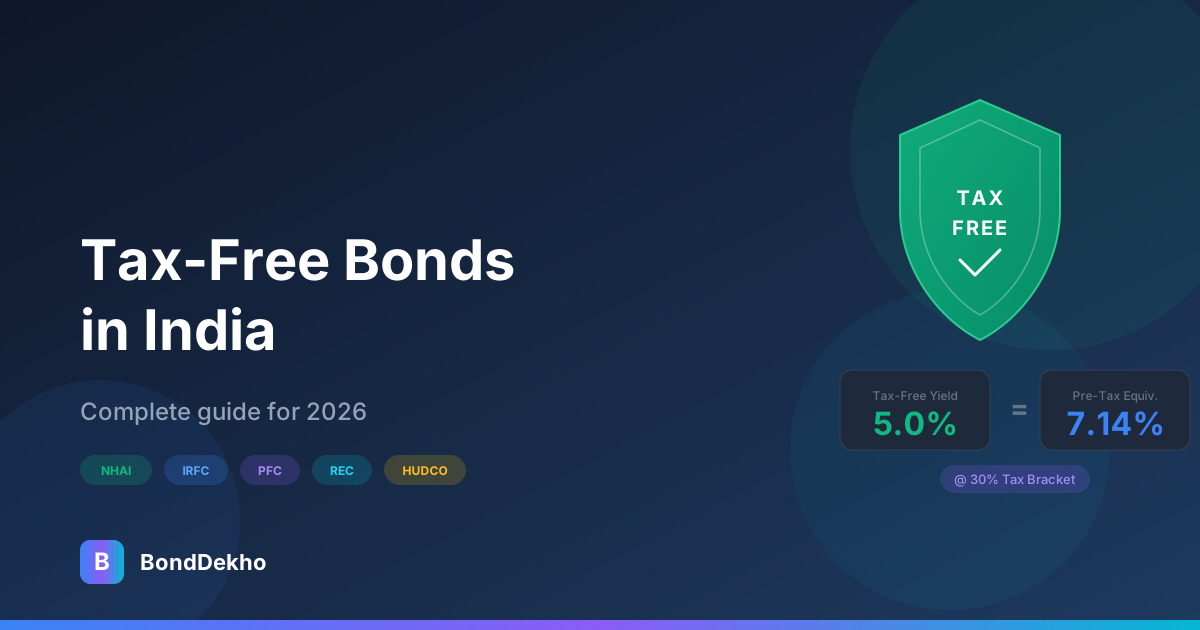
Quick answer: Tax-free bonds are fixed-income securities issued by eight government-backed entities — NHAI, IRFC, PFC, REC, HUDCO, NABARD, NTPC, and NHB — whose coupon income is fully exempt from income tax under Section 10(15)(iv)(h). No new bonds have been issued since 2016; the only access in 2026 is through BSE/NSE or bond platforms. Secondary-market YTMs are approximately 4.5–5.5%, but for a 30% bracket investor, a 5% tax-free yield is equivalent to earning 7.14% from a taxable bond. All carry AAA ratings with original tenures of 10, 15, or 20 years.
Imagine earning 5% interest on a bond and keeping every single rupee of it — no income tax deducted, no tax payable, no reporting headaches. That is exactly what tax-free bonds offer. For investors in the 30% tax bracket, a 5% tax-free yield is equivalent to earning roughly 7.14% from a regular taxable bond. In a world where every basis point matters, that tax advantage can be a powerful wealth-building tool.
Tax-free bonds were issued by government-backed entities between 2011 and 2016. While no new issuances have happened since, these bonds trade actively on stock exchanges and through bond platforms. This guide covers everything you need to know — from the basics of how they work to practical strategies for buying them in 2026.
What Are Tax-Free Bonds?
Tax-free bonds are fixed-income securities issued by government-backed infrastructure entities where the interest earned is completely exempt from income tax under Section 10(15)(iv)(h) of the Income Tax Act, 1961.
The key distinction: "tax-free" refers to the interest income being exempt. This is different from tax-saving bonds (Section 54EC), which help you save tax on capital gains. More on that difference later.
Who Issues Tax-Free Bonds?
Only specific government entities authorized by the Ministry of Finance can issue tax-free bonds. The eight approved issuers are:
| Issuer | Full Name | Sector |
|---|---|---|
| NHAI | National Highways Authority of India | Roads & Highways |
| IRFC | Indian Railway Finance Corporation | Railways |
| PFC | Power Finance Corporation | Power |
| REC | Rural Electrification Corporation | Power & Rural |
| HUDCO | Housing & Urban Development Corporation | Housing |
| NABARD | National Bank for Agriculture & Rural Development | Agriculture |
| NTPC | NTPC Limited | Power Generation |
| NHB | National Housing Bank | Housing Finance |
All these are either fully government-owned or government-backed entities. This sovereign lineage makes tax-free bonds among the highest-rated fixed-income instruments available to retail investors in India.
Key Features of Tax-Free Bonds
- Tenure: Typically 10, 15, or 20 years from the date of issue
- Interest payment: Annual (paid once a year)
- Coupon rate: Fixed at the time of issuance (ranges from 5.5% to 8.5% depending on the series)
- Face value: Usually Rs. 1,000 per bond
- Listing: All tax-free bonds are listed on BSE and NSE
- Credit rating: AAA rated (highest safety)
- Tax treatment: Interest is fully exempt under Section 10(15)(iv)(h)
How Do Tax-Free Bonds Work?
When you hold a tax-free bond, the issuer pays you interest annually at the coupon rate printed on the bond. This interest is entirely exempt from income tax — you do not need to add it to your taxable income, and no TDS is deducted on it.
Here is how a typical tax-free bond investment works:
Example: You buy an NHAI tax-free bond on the secondary market.
- Face value: Rs. 1,000
- Coupon rate: 7.28% (fixed at issuance in 2013)
- Annual interest: Rs. 72.80 per bond
- Tax on interest: Rs. 0 (completely exempt)
- Maturity: 2033 (20-year bond)
Every year until maturity, you receive Rs. 72.80 per bond, tax-free. At maturity, you get back the face value of Rs. 1,000.
The Tax Exemption Under Section 10(15)(iv)(h)
Section 10(15)(iv)(h) of the Income Tax Act specifically provides for tax exemption on interest earned from bonds notified by the Central Government. This exemption:
- Applies regardless of your tax bracket
- Applies under both the old and new tax regimes
- Requires no special claims or deductions — the interest is simply not taxable
- Has no upper limit — all interest from tax-free bonds is exempt
This is fundamentally different from deductions under Section 80C (which have a Rs. 1.5 lakh cap) or other tax-saving instruments. If you hold Rs. 50 lakhs worth of tax-free bonds earning 6% annually, the entire Rs. 3,00,000 interest is tax-free.
Current Yields in the Secondary Market
Since no new tax-free bonds have been issued since 2016, the only way to buy them in 2026 is through the secondary market — either on stock exchanges (BSE/NSE) or through bond platforms.
Secondary market prices fluctuate based on demand, supply, and prevailing interest rates. As of early 2026, tax-free bonds typically trade at a premium to their face value, resulting in yields lower than the original coupon rates.
Indicative Tax-Free Bond Yields (2026)
| Issuer | Coupon Rate | Market Price (Approx.) | YTM (Approx.) | Maturity |
|---|---|---|---|---|
| NHAI 2033 | 7.28% | Rs. 1,180-1,220 | 4.8-5.2% | 2033 |
| IRFC 2033 | 7.18% | Rs. 1,170-1,210 | 4.7-5.1% | 2033 |
| PFC 2033 | 7.50% | Rs. 1,190-1,240 | 4.9-5.3% | 2033 |
| REC 2028 | 7.11% | Rs. 1,050-1,080 | 4.5-5.0% | 2028 |
| HUDCO 2034 | 7.39% | Rs. 1,190-1,230 | 4.8-5.2% | 2034 |
Note: These are indicative figures. Use the BondDekho compare page to check current live prices and yields across platforms. You can also use our YTM calculator to compute the exact yield for any price and maturity combination.
A 4.5-5.5% tax-free yield may not sound exciting at first glance — until you calculate the tax-equivalent yield.
Tax-Equivalent Yield: The Real Advantage
The tax-equivalent yield tells you what a taxable bond would need to offer to match the after-tax return of a tax-free bond. The formula is straightforward:
Tax-Equivalent Yield = Tax-Free Yield / (1 - Tax Rate)
For someone in the 30% tax bracket, a 5% tax-free bond is equivalent to:
5% / (1 - 0.30) = 7.14% from a taxable bond
That is a significant advantage. Here is a comprehensive comparison:
Tax-Equivalent Yield Comparison
| Tax-Free Yield | 0% Bracket | 5% Bracket | 10% Bracket | 20% Bracket | 30% Bracket |
|---|---|---|---|---|---|
| 4.5% | 4.50% | 4.74% | 5.00% | 5.63% | 6.43% |
| 5.0% | 5.00% | 5.26% | 5.56% | 6.25% | 7.14% |
| 5.5% | 5.50% | 5.79% | 6.11% | 6.88% | 7.86% |
Reading this table: if you are in the 30% tax bracket and a tax-free bond yields 5.5%, you would need a regular taxable bond paying 7.86% to match that return after taxes. Since most AAA-rated taxable bonds offer 7.5-8.5% YTM, the tax-free advantage becomes very compelling — you get similar post-tax returns with arguably better credit quality (government-backed issuers).
For a deeper dive into how taxes affect bond returns across different scenarios, see our detailed bond taxation guide.
Who Should Invest in Tax-Free Bonds?
Tax-free bonds are not suitable for everyone. Their advantages are most pronounced for specific investor profiles.
Ideal Candidates
1. Investors in the 30% Tax Bracket
This is the sweet spot. At 30% marginal tax rate (plus cess), the tax-equivalent yield makes tax-free bonds competitive with much riskier corporate bonds. A 5% tax-free yield equals 7.14% pre-tax — and you get government-backed safety.
2. Retirees Seeking Safe, Tax-Efficient Income
Tax-free bonds provide annual interest payments without adding to taxable income. For senior citizens who already have income from pensions, FD interest, and other sources, tax-free bond interest does not push them into a higher bracket.
3. HNI (High Net Worth) Investors
For large portfolios (Rs. 50 lakhs or more in fixed income), the absolute tax savings are substantial. On Rs. 50 lakhs at 5% tax-free yield, you save roughly Rs. 75,000 in tax annually compared to a 7.14% taxable alternative in the 30% bracket.
4. Conservative Investors Prioritizing Safety
With AAA ratings and government backing, tax-free bonds offer a risk profile comparable to government securities. For capital preservation with tax-efficient income, they are hard to beat.
Who Should Avoid Them?
- Investors in the 0-10% tax bracket: The tax advantage is minimal. You would be better off with higher-yielding corporate bonds.
- Short-term investors: Tax-free bonds are long-duration instruments. If you need money within 1-2 years, liquidity can be an issue.
- Yield-seekers: If you are comfortable with AA/A-rated credit risk and want 9-11% returns, tax-free bonds at 4.5-5.5% will not satisfy you.
Use the income tax calculator to check your current tax bracket and determine whether tax-free bonds make sense for your situation.
How Are Tax-Free Bonds Different from Tax-Saving Bonds?
This is one of the most common sources of confusion. The two are fundamentally different instruments serving different purposes.
Tax-Free Bonds
- Tax benefit: Interest income is exempt from tax
- Issuers: Government-backed entities (NHAI, IRFC, PFC, etc.)
- Purpose: Generate tax-free income stream
- Lock-in: Tradeable on exchanges (no lock-in if bought from secondary market)
- Section: 10(15)(iv)(h) — exemption on interest
- Investment limit: No upper cap
- Current availability: Only in secondary market
Tax-Saving Bonds (Section 54EC)
- Tax benefit: Capital gains invested in these bonds are exempt from tax
- Issuers: NHAI and REC (Capital Gains Bonds)
- Purpose: Save tax on long-term capital gains from property sale
- Lock-in: Mandatory 5-year lock-in (no trading allowed)
- Section: 54EC — exemption on LTCG from property
- Investment limit: Rs. 50 lakhs per financial year
- Current availability: Available for fresh subscription
Side-by-Side Comparison
| Feature | Tax-Free Bonds | Tax-Saving Bonds (54EC) |
|---|---|---|
| Tax benefit on | Interest income | Capital gains from property |
| Interest taxable? | No | Yes (taxed at slab rate) |
| Coupon rate | 5.5-8.5% (at issuance) | 5.00% (current) |
| Lock-in period | None (traded on exchanges) | 5 years (mandatory) |
| Listing | Listed on BSE/NSE | Not listed |
| Liquidity | Moderate (secondary market) | None until maturity |
| Investment cap | No limit | Rs. 50 lakhs/year |
| Who needs it | High-bracket income earners | Property sellers with LTCG |
The short version: if you want tax-free income from your investments, you need tax-free bonds. If you have recently sold property and want to save capital gains tax, you need Section 54EC bonds. They solve completely different problems.
Tax-Free Bonds vs PPF vs ELSS: Where Do They Fit?
Investors often compare tax-free bonds with other popular tax-efficient instruments. Here is how they stack up:
| Feature | Tax-Free Bonds | PPF | ELSS (Tax-Saving MF) |
|---|---|---|---|
| Returns | 4.5-5.5% (YTM) | 7.1% (current rate) | 10-14% (historical avg) |
| Tax on returns | Exempt | Exempt | LTCG above Rs. 1.25L taxed at 12.5% |
| Section 80C benefit | No | Yes (up to Rs. 1.5L) | Yes (up to Rs. 1.5L) |
| Lock-in | None (secondary market) | 15 years (partial withdrawal after 7) | 3 years |
| Risk | Very low (govt-backed) | Zero (govt-guaranteed) | High (equity market risk) |
| Liquidity | Moderate | Low | Moderate (after lock-in) |
| Investment limit | No cap | Rs. 1.5 lakhs/year | No cap (80C limit Rs. 1.5L) |
| Often used for | Tax-free income in high bracket | Long-term safe savings | Wealth creation + 80C |
Tax-free bonds occupy a unique niche: they provide tax-exempt income with no investment limit and moderate liquidity, backed by government entities. PPF offers higher returns but locks your money for 15 years. ELSS offers potentially much higher returns but carries equity market risk.
For a comprehensive understanding of how yield calculations work and why YTM matters when buying bonds at a premium, read our guide to understanding bond yields.
Where Can You Buy Tax-Free Bonds in 2026?
Since no new issuances have taken place since 2016, the secondary market is your only option. There are two primary channels:
1. Stock Exchanges (BSE and NSE)
All tax-free bonds are listed on both BSE and NSE. You can buy them through your regular demat and trading account, just like you buy stocks.
How to buy on exchanges:
- Log in to your trading account (Zerodha, Groww, Angel One, etc.)
- Search for the bond by its ISIN or name (e.g., "NHAI N2 7.28%")
- Place a buy order at the market price or set a limit order
- Bonds are credited to your demat account on T+1
Advantages of exchange purchase:
- Transparent pricing (live bid/ask quotes)
- Lower transaction costs
- Direct demat holding
- No platform fees
Challenges:
- Liquidity can be thin (not all bonds trade daily)
- Odd lot sizes may not be available
- Need to understand order book dynamics
2. Bond Platforms (OBPPs)
Online Bond Platform Providers like GoldenPi, Wint Wealth, IndiaBonds, and others aggregate tax-free bond inventory and make it easier to browse and buy.
Advantages of platform purchase:
- Curated listings with yield calculations
- Easier for beginners
- Some platforms offer fractional lots
- Better discovery (filter by yield, maturity, issuer)
Challenges:
- Slightly wider spreads than direct exchange
- Platform fees may apply
- Available inventory varies by platform
You can compare tax-free bonds across platforms on BondDekho to find current pricing and yields across providers.
Tips for Buying Tax-Free Bonds in the Secondary Market
- Check the YTM, not just the coupon: A bond with 7.5% coupon trading at Rs. 1,200 has a much lower YTM than 7.5%. Always calculate the yield-to-maturity.
- Match maturity to your horizon: If you need the money in 3 years, do not buy a bond maturing in 2034. You will face interest rate risk if you sell early.
- Compare across platforms: Pricing varies between exchanges and OBPPs. A Rs. 5-10 price difference per bond adds up on large orders.
- Watch for accrued interest: When buying between interest payment dates, you pay accrued interest to the seller. This is recovered when you receive the next full coupon payment.
- Consider lot sizes: Exchange trades often happen in lots of 1 bond (Rs. 1,000 face value), but liquidity is better in larger lots.
Risks of Investing in Tax-Free Bonds
While tax-free bonds are among the safest fixed-income instruments, they are not risk-free. Understanding the risks helps you make informed decisions.
1. Interest Rate Risk
This is the primary risk. When interest rates rise, bond prices fall — and vice versa. Tax-free bonds have long tenures (10-20 years), making them highly sensitive to rate changes.
Example: If rates rise by 1%, a bond maturing in 10 years could see its market price drop by 7-9%. If you sell before maturity, you could incur a capital loss. However, if you hold to maturity, you receive the full face value regardless of interim price fluctuations.
2. Liquidity Risk
Tax-free bonds do not trade as actively as stocks or government securities. On some days, specific bonds may have no buyers or sellers. This can be a problem if you need to exit urgently.
Mitigation: Stick to bonds from larger issuers (NHAI, IRFC, PFC) which tend to have better liquidity. Avoid obscure series with very small outstanding amounts.
3. Capital Gains Tax on Sale
While the interest is tax-free, capital gains on selling tax-free bonds before maturity are taxable.
- Listed bonds held over 12 months: Long-term capital gains taxed at 12.5%
- Listed bonds held 12 months or less: Short-term capital gains taxed at your slab rate
- At maturity: If bought at a discount to face value, the difference is treated as capital gain
This means if you buy at Rs. 1,000 and sell at Rs. 1,150, the Rs. 150 gain is taxable. Only the interest is exempt.
4. Reinvestment Risk
When a tax-free bond matures, you get your principal back — but you cannot reinvest in new tax-free bonds (since none are being issued). You will likely have to settle for lower post-tax returns from alternative instruments.
5. Inflation Risk
At 4.5-5.5% yields, tax-free bonds barely keep pace with inflation during high-inflation years. If CPI inflation averages 5-6%, your real return could be near zero or even negative. This is the trade-off for safety and tax efficiency.
Tax-Free Bonds: Tax Treatment Summary
| Component | Tax Treatment |
|---|---|
| Interest income | Fully exempt under Section 10(15)(iv)(h) |
| Short-term capital gains (held ≤ 12 months) | Taxed at slab rate |
| Long-term capital gains (held > 12 months) | 12.5% flat rate |
| TDS on interest | Not applicable (no TDS deducted) |
| Wealth tax | Not applicable (abolished) |
| Reporting in ITR | Interest reported as exempt income in Schedule EI |
Should You Buy Tax-Free Bonds at a Premium?
Most tax-free bonds in 2026 trade above their face value (at a premium). This happens because the coupon rates set in 2012-2015 (6.5-8.5%) are higher than current market yields. Buying at a premium means:
- Your YTM will be lower than the coupon rate
- You will receive a capital loss at maturity (bought at Rs. 1,200, redeemed at Rs. 1,000)
- This capital loss can be set off against other capital gains
Example calculation:
- Buy NHAI bond at Rs. 1,200
- Coupon: 7.28% on Rs. 1,000 face value = Rs. 72.80/year (tax-free)
- Years to maturity: 7 years
- Capital loss at maturity: Rs. 200
- Approximate YTM: ~4.9% (all tax-free)
Even at a premium, the post-tax return often beats comparable taxable alternatives for high-bracket investors. The capital loss at maturity can also offset gains from other investments, providing an additional tax benefit.
Building a Tax-Efficient Portfolio with Tax-Free Bonds
Tax-free bonds work well as part of a broader fixed-income allocation. Here is how they might fit into different portfolio strategies:
Conservative Portfolio (High Tax Bracket)
| Allocation | Instrument | Expected Yield | Post-Tax Yield (30% bracket) |
|---|---|---|---|
| 40% | Tax-free bonds | 5.0% | 5.0% (exempt) |
| 30% | AAA corporate bonds | 8.0% | 5.6% |
| 20% | G-Secs / SDL | 7.2% | 5.0% |
| 10% | Short-term debt funds | 7.5% | 5.3% |
| Blended | 5.15% |
In this portfolio, the tax-free bond allocation delivers the highest post-tax yield despite having the lowest pre-tax yield. That is the power of tax exemption.
Key Principles
- Allocate tax-free bonds based on your tax bracket: Higher bracket = higher allocation justified
- Match maturities to your goals: Use tax-free bonds for long-term goals where you do not need interim liquidity
- Diversify across issuers: Even though all are government-backed, spread across NHAI, IRFC, PFC, and others
- Complement with taxable bonds: For shorter-term needs or higher yield requirements, add corporate bonds — compare options on BondDekho
Frequently Asked Questions
Are tax-free bonds really 100% tax-free?
The interest income is 100% exempt from income tax. However, capital gains (if you sell before maturity at a profit) are taxable. Also, if you receive interest from tax-free bonds, it does not count towards any deduction limit — it is simply exempt income.
Can NRIs invest in tax-free bonds?
Yes, NRIs can buy tax-free bonds in the secondary market through their NRE/NRO demat accounts. The interest remains tax-free in India. However, NRIs should check the tax implications in their country of residence, as DTAA provisions vary.
Will the government issue new tax-free bonds?
There has been no indication of new tax-free bond issuances. The government shifted to taxable bonds (like Floating Rate Savings Bonds) as a borrowing tool. However, policy can change — any new issuance would be announced through RBI and Ministry of Finance.
What happens when my tax-free bond matures?
You receive the face value (Rs. 1,000 per bond) credited to your bank account linked to your demat. If you bought at a premium, the difference between purchase price and face value is treated as a capital loss (can be set off against capital gains).
Conclusion
Tax-free bonds remain one of the most efficient fixed-income instruments for investors in higher tax brackets. While no new bonds have been issued since 2016, the secondary market offers ample opportunities to add these to your portfolio. The combination of government-backed safety, complete tax exemption on interest, and listing on exchanges makes them a compelling choice for conservative, tax-conscious investors.
The key is to focus on the tax-equivalent yield rather than the nominal yield. At 5% tax-free, you are effectively earning 7.14% pre-tax in the 30% bracket — with AAA-rated government-backed safety that few corporate bonds can match.
Before investing, calculate your actual tax bracket, compare available yields across platforms, and ensure the bond's maturity aligns with your financial goals.
Compare tax-free bonds across platforms on BondDekho. Use our YTM calculator to compute exact yields for any bond at current market prices.
Disclaimer: This article is for educational and informational purposes only. BondDekho is not SEBI-registered and does not provide investment advice. Tax rules mentioned are based on current tax laws and subject to change. Consult a qualified tax advisor for advice specific to your situation.