What Is Bond Duration and Why It Matters
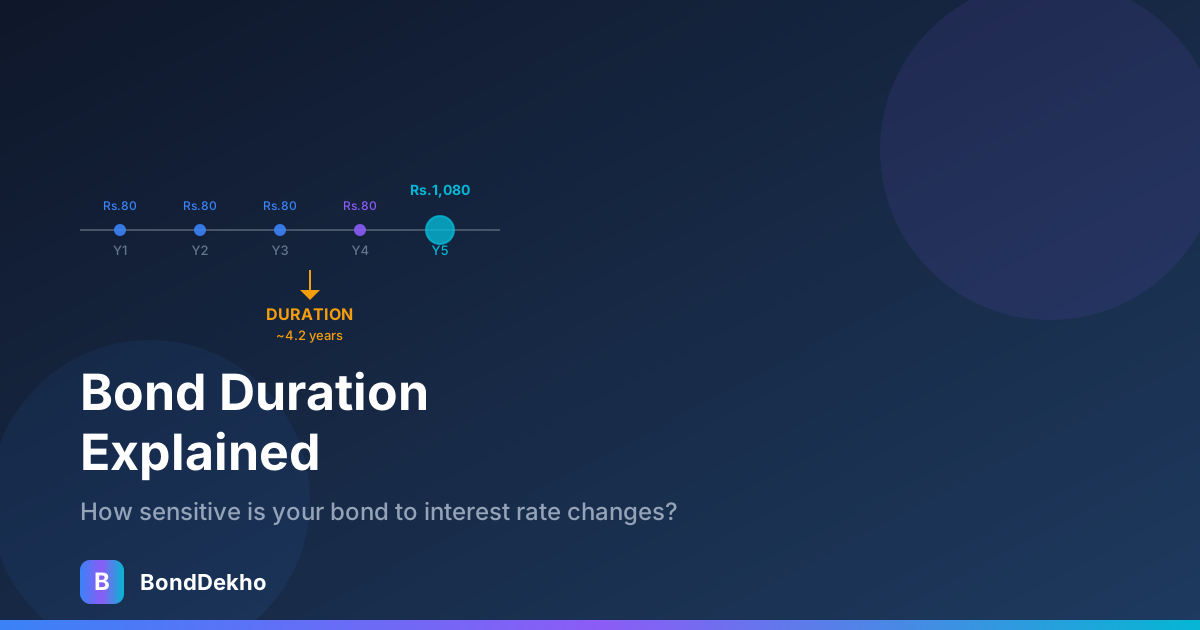
Quick answer: Duration measures how sensitive a bond's price is to interest rate changes: a bond with 5-year duration falls roughly 5% in price when rates rise by 1%, while a 2-year duration bond falls only ~2%. Think of it as the weighted average time to receive all of a bond's cash flows. A zero coupon bond's duration equals its maturity; a coupon-paying bond's duration is always shorter because earlier cash flows pull the average forward. A 5-year NCD paying 10% coupon has ~4.2 years of duration versus 5.0 years for a 5-year zero coupon bond. Higher coupons shorten duration.
You've probably heard that bond prices fall when interest rates rise. But by how much? A 2-year bond and a 20-year bond don't react the same way to a rate hike. The concept that explains this difference is duration — and understanding it can help you make smarter bond investment decisions.
Don't worry — this isn't a math lecture. We'll explain duration intuitively, with simple examples that any investor can follow.
Key Takeaways
- Duration measures how sensitive a bond's price is to interest rate changes — it's the single most important risk metric for bond investors after credit rating.
- Think of duration as the "weighted average time to get your money back" — a bond that returns your money faster has lower duration and less interest rate risk.
- Higher duration means more price volatility — a bond with 7-year duration will drop roughly 7% in price if interest rates rise by 1%, while a 2-year duration bond drops only about 2%.
- Coupon rate affects duration — higher coupon bonds have shorter duration because you get more cash back sooner, reducing your exposure to rate changes.
- Duration matters even if you plan to hold to maturity — it affects opportunity cost and the market value of your portfolio if you ever need to sell early.
- For most retail investors on OBPPs, shorter duration means less surprises — if you're unsure about rate movements, bonds with 1-3 year duration offer a good balance of yield and stability.
- Duration is not the same as maturity — a 10-year bond with high coupons can have shorter duration than a 7-year zero-coupon bond.
What Is Bond Duration?
Duration answers a simple question: how long, on average, does it take to get your money back from a bond?
When you buy a bond, you receive cash flows over time — periodic coupon payments and the final principal repayment at maturity. Duration calculates the weighted average timing of all these cash flows, where bigger payments get more weight.
A Simple Analogy
Imagine you lend Rs. 1,00,000 to two friends:
- Friend A pays you Rs. 20,000 every year for 5 years (returns money gradually)
- Friend B pays you nothing for 5 years, then Rs. 1,00,000 + interest all at once
Both loans mature in 5 years, but Friend A returns your money much faster on average. If interest rates suddenly rise and you want your money back to reinvest at better rates, Friend A's deal is far more flexible.
Friend A's loan has shorter duration. Friend B's has longer duration (close to 5 years, since you wait until the very end).
This is exactly how bonds work.
How Does Duration Differ from Maturity?
Maturity tells you when a bond's life ends. Duration tells you the effective timeline for getting your cash back.
| Bond | Maturity | Coupon | Duration (approx.) |
|---|---|---|---|
| 5-year NCD, 10% coupon | 5 years | Rs. 100/year on Rs. 1,000 face | ~4.2 years |
| 5-year zero-coupon bond | 5 years | None (all at maturity) | 5.0 years |
| 10-year G-Sec, 7.5% coupon | 10 years | Rs. 75/year on Rs. 1,000 face | ~7.5 years |
| 3-year NCD, 9% coupon | 3 years | Rs. 90/year on Rs. 1,000 face | ~2.7 years |
Notice the pattern: the zero-coupon bond's duration equals its maturity (because you get nothing until the end), while coupon-paying bonds always have duration shorter than maturity.
Why Does Duration Matter for Bond Prices?
Here's the practical payoff: duration tells you approximately how much a bond's price will move when interest rates change.
The rule of thumb: If a bond has a duration of X years, its price will change by approximately X% for every 1% change in interest rates.
Example
You hold a bond with 5-year duration, currently priced at Rs. 1,000:
| Rate Change | Price Impact | New Price (approx.) |
|---|---|---|
| Rates rise 0.5% | -2.5% | Rs. 975 |
| Rates rise 1.0% | -5.0% | Rs. 950 |
| Rates fall 0.5% | +2.5% | Rs. 1,025 |
| Rates fall 1.0% | +5.0% | Rs. 1,050 |
Now compare this to a bond with 2-year duration:
| Rate Change | Price Impact | New Price (approx.) |
|---|---|---|
| Rates rise 1.0% | -2.0% | Rs. 980 |
| Rates fall 1.0% | +2.0% | Rs. 1,020 |
The 5-year duration bond moves 2.5x more than the 2-year duration bond for the same rate change. This is why duration matters — it quantifies interest rate risk.
For a deeper dive into how rate changes affect bond prices, see our guide on bond prices and market dynamics.
What Is Modified Duration?
You may see "modified duration" on some platforms. It's simply a slightly adjusted version of duration that gives a more precise price sensitivity estimate.
The difference is small for most retail investors. If a bond's (Macaulay) duration is 5 years and its YTM is 8%, the modified duration would be:
Modified Duration = Duration ÷ (1 + YTM) = 5 ÷ 1.08 ≈ 4.63
This means the price changes by about 4.63% for a 1% rate move, rather than 5%. The concept is the same — modified duration is just a finer-tuned version of the same idea.
For most buy-and-hold investors, you don't need to worry about the distinction. Just know that higher duration = more rate sensitivity.
How Does Coupon Rate Affect Duration?
Higher coupons shorten duration. Here's why:
When a bond pays a large coupon, you receive a significant portion of your total return early in the bond's life. These early cash flows reduce the weighted average time to get your money back.
| Bond Type | Maturity | Coupon | Duration |
|---|---|---|---|
| High coupon NCD | 5 years | 11% | ~3.9 years |
| Medium coupon NCD | 5 years | 8% | ~4.3 years |
| Low coupon NCD | 5 years | 5% | ~4.6 years |
| Zero coupon | 5 years | 0% | 5.0 years |
This creates a useful insight: two bonds with the same maturity can have very different risk profiles depending on their coupon rates. A high-coupon 5-year bond behaves more like a shorter-term bond than a low-coupon 5-year bond.
Should You Care About Duration if You Hold to Maturity?
This is a common question, and the answer is nuanced.
If you buy a bond and hold it until maturity, interim price fluctuations don't directly affect your return — you'll receive the promised YTM regardless of what happens to rates in between. In that sense, duration doesn't matter.
But here's where it still matters:
- Opportunity cost — If rates rise sharply after you buy a long-duration bond, you're locked into a lower yield while new bonds offer more. A bond ladder can help manage this.
- Emergency liquidity — If you ever need to sell before maturity, a high-duration bond might be worth significantly less than you paid, depending on how rates have moved.
- Reinvestment decisions — When coupons come in, you reinvest them at the prevailing rate. Higher duration means more of your return depends on the final maturity payment, making reinvestment less of a factor.
Bottom line: Duration matters less for strict hold-to-maturity investors, but life doesn't always go as planned. Understanding duration helps you pick bonds that match your flexibility needs.
How Can You Use Duration When Comparing Bonds on OBPPs?
When browsing bonds on platforms like GoldenPi, WintWealth, or IndiaBonds, here's how to use duration thinking:
If You Expect Rates to Fall
Longer-duration bonds benefit more from rate cuts. If RBI signals an easing cycle, bonds with 5-7 year duration could see meaningful price appreciation.
If You Expect Rates to Rise
Shorter-duration bonds (1-3 years) protect you from price drops. Your capital is returned sooner, and you can reinvest at higher rates.
If You're Unsure
Stick to moderate duration (2-4 years). You get a reasonable yield without excessive rate sensitivity. This is also where bond laddering shines — spreading maturities across 1-5 years gives you natural duration diversification.
Quick Reference
| Your Situation | Duration Target | Why |
|---|---|---|
| Need money in 1-2 years | 1-2 years | Minimise price risk |
| Comfortable for 3-5 years | 3-5 years | Balance of yield and stability |
| Betting on rate cuts | 5-7+ years | Maximise price gains |
| Building regular income | Mixed (ladder) | Natural diversification |
Duration vs Other Risk Metrics
Duration isn't the only thing to consider. Here's how it fits alongside other bond risk factors:
| Risk Factor | What It Measures | Key Metric |
|---|---|---|
| Duration | Interest rate sensitivity | Years (lower = less volatile) |
| Credit Rating | Default probability | AAA to D (higher = safer) |
| YTM | Expected return | Percentage (accounts for price + coupons) |
| Liquidity | Ease of selling | Trading volume, bid-ask spread |
For most retail investors, credit rating and YTM are the first filters. Duration becomes the tiebreaker — among bonds with similar ratings and yields, shorter duration means less surprises.
The Bottom Line
Duration is one of those concepts that sounds technical but boils down to common sense: the longer you have to wait for your money, the more things can change. Shorter duration means less waiting, less uncertainty, and less price volatility.
You don't need to calculate duration yourself — platforms and bond databases display it. But knowing what the number means helps you:
- Compare bonds beyond just yield and rating
- Match your bond choices to your view on interest rates
- Build a portfolio that behaves the way you expect
Understanding duration puts you ahead of most retail bond investors in India. Combined with knowledge of how bond prices move and how to read bond terms, you have the tools to make informed fixed income decisions.
Disclaimer: This article is for educational purposes only and should not be construed as investment advice. Bond investments carry risks including interest rate risk and credit risk. Please consult a SEBI-registered investment adviser before making investment decisions.