How Bond Settlement Works in India: What Happens After You Click Buy
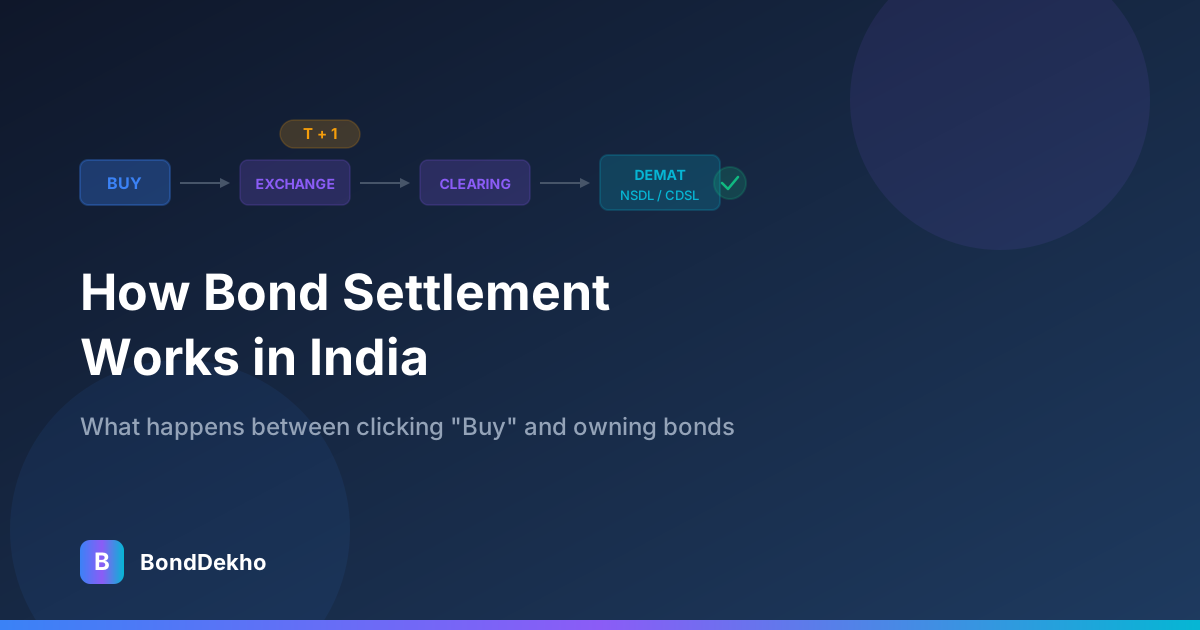
Quick answer: Bond settlement is the process that transfers bonds to your demat account and money to the seller. Exchange-traded bonds in India settle T+1 — one business day after the trade date, the same timeline as equity shares since January 2023. OBPPs may settle T+0 to T+2 depending on whether they hold inventory or route via an exchange. You pay the dirty price (clean price plus accrued interest), not the listed price. Interest accrual on your holding begins from the settlement date, not the order date. Holdings are held electronically at NSDL or CDSL and verifiable independently of your platform.
You've done your research, compared yields on BondDekho, picked a bond, and clicked "Buy" on an OBPP. But what actually happens next? How does a digital transaction turn into a bond sitting in your demat account? And how long does it take?
Bond settlement in India follows a well-defined process regulated by SEBI, stock exchanges, and depositories. Understanding it helps you plan your cash flows, avoid surprises, and know exactly when your investment becomes official. This guide walks you through every step.
Key Takeaways
- Bond settlement is the process of transferring bonds to your demat account and money to the seller — it's the backend that makes your purchase official.
- Exchange-traded bonds settle on T+1 — if you buy on Monday, bonds land in your demat by Tuesday. This is the same timeline as equity shares since January 2023.
- OBPPs may have varying timelines (T+0 to T+2) — some platforms hold inventory and transfer faster, while others route through exchanges and follow standard settlement.
- You need a demat account to hold bonds — bonds are held electronically at NSDL or CDSL, just like shares. No physical certificates.
- Clean price vs dirty price matters — the price you see listed is often the "clean price" (without accrued interest), but you pay the "dirty price" (clean price + accrued interest since last coupon).
- Failed settlements are rare but possible — insufficient funds, demat issues, or platform errors can delay settlement. Exchanges have penalty mechanisms for failures.
- You can verify your holdings directly — NSDL and CDSL offer free apps and web portals to check your bond holdings independent of any platform.
What Happens After You Click "Buy"?
Here's the journey of a typical bond purchase, step by step:
Step 1: Order Placement
You place a buy order on an OBPP (like GoldenPi, WintWealth, or IndiaBonds) or through your broker on NSE/BSE. The platform confirms the order details — ISIN, quantity, price, and total amount including accrued interest.
Step 2: Order Matching
For exchange-traded bonds, your buy order is matched with a sell order on the exchange's order book. On OBPPs, the platform may sell from its own inventory or route through an exchange.
Step 3: Trade Confirmation
You receive a trade confirmation (also called a contract note) with the trade details — ISIN, settlement date, quantity, clean price, accrued interest, and total consideration.
Step 4: Clearing and Settlement
The clearing corporation (NSE Clearing or Indian Clearing Corporation for BSE) steps in as the counterparty to both buyer and seller. This guarantees settlement even if one party defaults.
Step 5: Delivery
On the settlement date:
- Your money is debited and sent to the seller
- The bonds are transferred from the seller's demat account to yours
- The transaction appears in your demat holding statement
Step 6: Confirmation
You can verify the bonds in your demat account through your depository participant (DP), NSDL/CDSL apps, or the OBPP's portfolio view.
What Are the Settlement Timelines?
Settlement timelines depend on where and how you buy:
| Purchase Channel | Settlement Cycle | When You Get Bonds |
|---|---|---|
| NSE/BSE (exchange) | T+1 | Next business day |
| OBPP (exchange route) | T+1 | Next business day |
| OBPP (inventory/OTC) | T+0 to T+2 | Same day to 2 business days |
| RBI Retail Direct (G-Secs) | T+1 | Next business day |
| New issue / IPO (NCD) | Listing day | 4-6 business days after allotment |
"T" means the trade date — the day you execute the order. T+1 means one business day after the trade. Weekends and exchange holidays don't count.
What About Interest?
An important nuance: you start earning interest from the settlement date, not the order date. If you buy on Monday and settlement happens Tuesday (T+1), your interest accrual begins Tuesday.
For most retail purchases, this one-day difference is negligible. But for large trades or short-duration bonds, it's worth noting.
What Are NSDL and CDSL?
Just as your money sits in a bank, your bonds sit in a depository. India has two:
| NSDL | CDSL | |
|---|---|---|
| Full Name | National Securities Depository Limited | Central Depository Services Limited |
| Established | 1996 | 1999 |
| Promoted By | NSE, IDBI Bank, UTI | BSE |
| App | NSDL e-CAS, Speed-e | myeasigov (earlier: Easi/Easiest) |
| Reach | ~3.5 crore demat accounts | ~12 crore demat accounts |
Your Depository Participant (DP) is the intermediary between you and the depository — usually your broker (Zerodha, Groww, etc.) or a bank. When you open a demat account, you're opening it through a DP who is registered with either NSDL or CDSL.
Both depositories work the same way for bonds. Your ISIN-identified bonds are stored as electronic entries. You can hold bonds from any exchange in either depository.
If you're setting up your demat account for the first time, our step-by-step investing guide covers the process.
What Is the Difference Between Clean Price and Dirty Price?
This is one of the most common sources of confusion for new bond investors.
Clean Price
The price you see quoted on most platforms and exchanges. It excludes accrued interest — the interest that has built up since the last coupon payment date.
Dirty Price
The price you actually pay (or receive when selling). It equals the clean price plus accrued interest.
Dirty Price = Clean Price + Accrued Interest
Why Does This Matter?
Suppose you buy a bond mid-way between two coupon dates:
| Detail | Value |
|---|---|
| Face value | Rs. 1,000 |
| Coupon rate | 9% (annual, paid semi-annually) |
| Last coupon paid | 3 months ago |
| Clean price | Rs. 1,020 |
| Accrued interest | Rs. 22.50 (3 months of 4.5% semi-annual) |
| Dirty price (you pay) | Rs. 1,042.50 |
When the next coupon is paid (in 3 months), you'll receive the full Rs. 45 semi-annual coupon — even though you only held the bond for 3 of the 6 months. The accrued interest you paid at purchase compensates the seller for the 3 months they held it.
On OBPPs: Most platforms show you the total amount you'll pay (dirty price) at checkout, even if the listed price is clean. Always check the order summary before confirming.
How Does Settlement Differ on OBPPs vs Exchanges?
| Aspect | Exchange (NSE/BSE) | OBPP |
|---|---|---|
| Order matching | Public order book, anonymous | Platform-mediated or inventory |
| Settlement guarantee | Clearing corporation guaranteed | Depends on route (exchange-backed or bilateral) |
| Timeline | T+1 (standardised) | T+0 to T+2 (varies by platform) |
| Minimum lot | 1 bond (face value Rs. 1,000 typically) | Platform-specific (some require Rs. 10,000+) |
| Price discovery | Market-driven bid/ask | Platform sets price or routes to exchange |
| Contract note | Issued by broker | Issued by platform |
| Regulation | SEBI + Exchange rules | SEBI OBPP framework |
Many OBPPs route orders through exchanges behind the scenes, giving you the same settlement guarantee. Others maintain their own bond inventory and transfer directly. The OBPP's FAQ or terms of service will specify which model they use.
For a comparison of how different platforms operate, see our OBPP platforms guide.
What Can Go Wrong During Settlement?
Settlement failures are uncommon in India's bond market, but they can happen:
Insufficient Funds
If your bank account or trading account doesn't have enough funds on settlement day, the trade may be cancelled or penalised. Most platforms block the funds upfront to prevent this.
Demat Account Issues
If your demat account has a freeze (due to KYC non-compliance or a regulatory hold), bonds can't be credited. Ensure your KYC is current with your DP.
Short Delivery by Seller
The seller may fail to deliver bonds. In exchange trades, the clearing corporation's auction mechanism handles this — you'll either get the bonds (purchased from another seller at the defaulter's cost) or receive financial compensation.
Platform Technical Errors
Rare, but possible. If an OBPP's system fails to process your order correctly, reach out to their support with your order ID and trade confirmation. SEBI's OBPP regulations require platforms to have grievance redressal mechanisms.
Delayed Credit
Sometimes bonds appear in your demat a few hours after the expected time due to batch processing by depositories. If bonds don't appear within 24 hours of the expected settlement date, contact your DP or platform.
How Can You Check Your Bond Holdings After Purchase?
Don't rely solely on the platform's portfolio view. You can independently verify:
NSDL
- Internet: Visit the NSDL IDeAS portal and log in with your DP ID + Client ID
- App: Download "NSDL e-CAS" for a consolidated account statement
- Email: NSDL sends a monthly Consolidated Account Statement (CAS) to your registered email
CDSL
- Internet: Log in to myeasigov portal
- App: Use the myeasigov mobile app
- Email: Monthly CAS delivered to registered email, same as NSDL
Your Broker/DP
Most brokers (Zerodha, Groww, Angel One, etc.) show bond holdings in their app alongside equity holdings. Look for the "Holdings" or "Portfolio" section — bonds appear with their ISIN and face value.
Reading Your Statement
A typical demat statement entry for a bond looks like:
| Field | Example |
|---|---|
| ISIN | INE123A07XXX |
| Security Name | XYZ Corp NCD 9% 2028 |
| Quantity | 10 |
| Face Value | Rs. 1,000 |
| Total Value | Rs. 10,000 (face value, not market value) |
The statement shows face value, not current market value. To check market value, look up the ISIN on an exchange or compare prices on BondDekho.
Bond Settlement for New Issues (IPOs/NFOs)
When you apply for a new bond issue (like a public NCD issue), the settlement process is different:
- Application period: You apply and money is blocked from your bank account
- Allotment: The issuer allots bonds based on demand (oversubscription may mean partial allotment)
- Refund: Unallotted amount is returned to your bank (typically 4-5 business days)
- Credit to demat: Allotted bonds appear in your demat account
- Listing: Bonds list on the exchange (usually 6-12 business days after issue close)
After listing, regular T+1 settlement applies for any secondary market trades.
The Bottom Line
Bond settlement in India is a well-regulated, largely automated process. For most retail investors buying through OBPPs or brokers, the experience is seamless — click buy, money debits, bonds appear in your demat within a day or two.
The key things to remember:
- Exchange bonds settle T+1 — fast and guaranteed
- You pay the dirty price (clean price + accrued interest) — check the total at checkout
- Verify holdings independently through NSDL/CDSL, not just the platform
- Keep your KYC current to avoid demat freezes
Understanding settlement removes the mystery from bond investing. Combined with knowing how to evaluate bonds and how prices move in the market, you have a complete picture of what happens from research to ownership.
Disclaimer: This article is for educational purposes only and should not be construed as investment advice. Bond investments carry risks including interest rate risk and credit risk. Please consult a SEBI-registered investment adviser before making investment decisions.