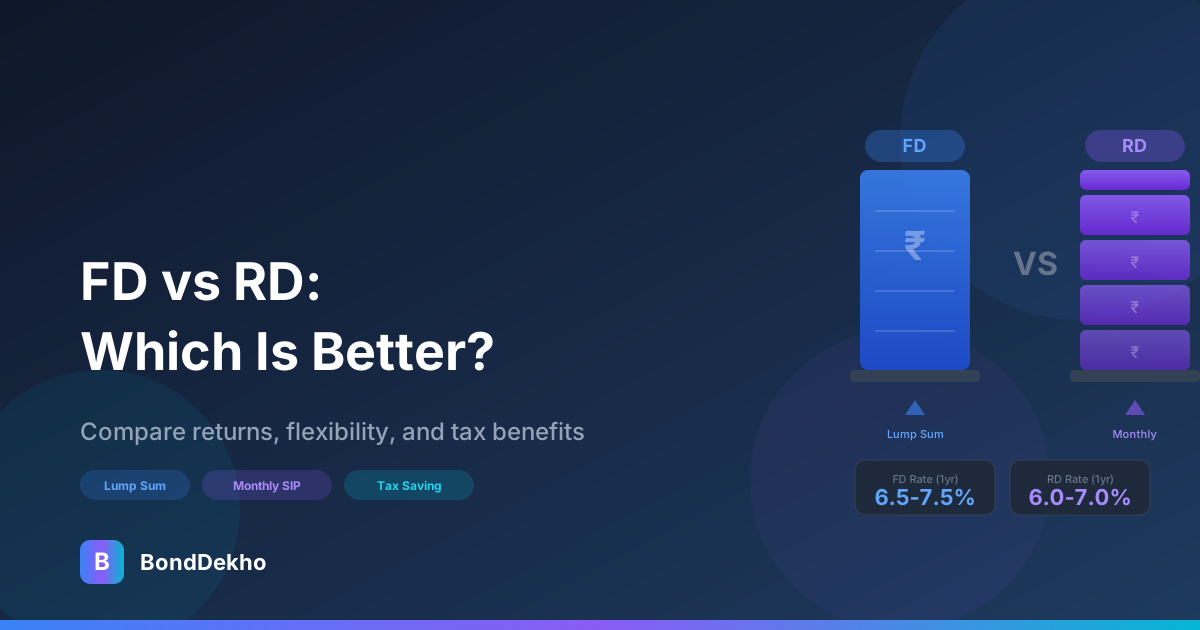
FD vs RD: Which Is Better for Your Investment Goals?
Quick answer: The FD vs RD choice hinges on whether you have a lump sum or save monthly. Both are covered by DICGC deposit insurance up to Rs. 5 lakh per bank and both pay interest taxed at your slab rate. Even when FD and RD rates are similar, an FD generates substantially more total interest because your full principal earns from day one: Rs. 1,20,000 deployed upfront at 7.0% in an FD yields Rs. 8,628, while the same total spread across 12 monthly RD instalments at a comparable rate yields Rs. 4,440 — because the average capital deployed in the RD is lower through the year. TDS applies on interest above Rs. 40,000 per year (Rs. 50,000 for senior citizens).
Fixed Deposits (FDs) and Recurring Deposits (RDs) are the two most popular savings instruments in India. Every bank offers them, every family uses them, and they remain the default choice for conservative investors who prioritise safety over high returns. According to RBI data, banks in India hold over Rs. 200 lakh crore in term deposits — a staggering number that underscores just how deeply these products are embedded in Indian financial culture.
Yet despite their popularity, there is a surprising amount of confusion about how FDs and RDs differ, which one gives better returns, and when each one fits your situation. The answer is not always straightforward, because it depends on your financial situation — specifically, whether you have a lump sum to invest or prefer to save monthly.
This guide breaks down every meaningful difference between FDs and RDs — from how interest is calculated, to tax treatment, to real-world return comparisons across major banks. By the end, you will have a clear framework for deciding which instrument fits your goals.
What Is a Fixed Deposit (FD)?
A Fixed Deposit is a lump sum investment made with a bank or NBFC for a fixed period at a predetermined interest rate. When the FD matures, you receive your principal plus the accumulated interest.
Key characteristics:
- Investment type: One-time lump sum
- Tenure: 7 days to 10 years (varies by bank)
- Interest rate: Fixed at the time of deposit (some banks offer floating-rate FDs)
- Interest payout: Monthly, quarterly, annually, or cumulative (compounded and paid at maturity)
- Premature withdrawal: Allowed with a penalty (typically 0.5-1% reduction in interest rate)
- Deposit insurance: Covered up to Rs. 5 lakh per bank under DICGC
- Minimum amount: Rs. 1,000 to Rs. 10,000 (varies by bank)
Example: You deposit Rs. 5,00,000 in a 1-year FD at 7.0% interest (quarterly compounding). At maturity, you receive approximately Rs. 5,35,869 — your principal plus Rs. 35,869 in interest.
How FD Interest Is Calculated
FD interest is calculated using the compound interest formula:
Maturity Amount = P x (1 + r/n)^(n x t)
Where:
- P = Principal amount
- r = Annual interest rate
- n = Number of compounding periods per year (4 for quarterly)
- t = Tenure in years
Most banks compound FD interest quarterly. This means interest earned in Q1 earns interest in Q2, and so on. The effective annual yield is slightly higher than the stated rate due to compounding.
| Stated Rate | Compounding | Effective Annual Yield |
|---|---|---|
| 7.00% | Quarterly | 7.19% |
| 7.00% | Monthly | 7.23% |
| 7.00% | Annual | 7.00% |
What Is a Recurring Deposit (RD)?
A Recurring Deposit is a systematic savings instrument where you deposit a fixed amount every month for a predetermined period. At maturity, you receive the total deposits plus accumulated interest.
Key characteristics:
- Investment type: Monthly fixed installments
- Tenure: 6 months to 10 years (varies by bank)
- Interest rate: Fixed at the time of opening (usually same as or slightly lower than FD rates)
- Interest calculation: Quarterly compounding on each monthly installment
- Premature closure: Allowed with penalty
- Missed installments: Usually 1-2 missed payments allowed before account closure
- Deposit insurance: Covered up to Rs. 5 lakh per bank under DICGC
- Minimum amount: Rs. 100 to Rs. 1,000 per month (varies by bank)
Example: You invest Rs. 10,000 per month in a 1-year RD at 6.8% interest. Over 12 months, you deposit Rs. 1,20,000. At maturity, you receive approximately Rs. 1,24,440 — your deposits plus Rs. 4,440 in interest.
How RD Interest Is Calculated
RD interest calculation is more complex than FD because each monthly installment earns interest for a different duration. The first installment earns interest for 12 months, the second for 11 months, and so on.
Banks use the following approach:
- Each monthly installment is treated like a separate mini-FD
- Interest is compounded quarterly
- The total interest is the sum of interest earned on each installment
This is why the effective interest earned on an RD is lower than what you would earn on an FD for the same amount. In an FD, your entire principal earns interest for the full tenure. In an RD, only the first installment gets the full benefit; subsequent installments earn progressively less.
Use the SBI RD calculator or our RD calculator to compute exact returns for your specific monthly amount and tenure.
What Is the Difference Between FD and RD Returns?
This is the most important question, and the answer surprises many people. Even when FD and RD interest rates are identical, the FD generates higher total returns. The reason is simple: in an FD, your entire principal is working from day one.
Side-by-Side Return Comparison
Let us compare a Rs. 1,20,000 investment over 1 year at 7.0% interest:
Scenario A: FD (Lump Sum)
- Deposit: Rs. 1,20,000 on Day 1
- Interest earned (quarterly compounding): Rs. 8,628
- Maturity value: Rs. 1,28,628
- Effective return on total investment: 7.19%
Scenario B: RD (Rs. 10,000/month for 12 months)
- Total deposited: Rs. 1,20,000 (over 12 months)
- Interest earned: Rs. 4,440
- Maturity value: Rs. 1,24,440
- Effective return on total investment: 3.70%
Wait — 3.70%? That seems dramatically lower. But it makes perfect sense when you understand that in the RD, your average invested capital over the year is only about Rs. 65,000 (the average of Rs. 10,000 in month 1 and Rs. 1,20,000 in month 12). The interest rate applied to each installment is still 7.0%, but the time each installment earns interest varies.
The takeaway: FDs earn more total interest because your money is fully deployed from the start. RDs are not inferior — they simply serve a different purpose (regular savings vs. lump sum deployment).
Detailed Comparison Table
| Factor | Fixed Deposit (FD) | Recurring Deposit (RD) |
|---|---|---|
| Investment mode | One-time lump sum | Monthly installments |
| Interest rate | Typically 0-0.25% higher than RD | Slightly lower or equal to FD |
| Compounding | Quarterly (usually) | Quarterly on each installment |
| Total interest earned | Higher (full principal works from day 1) | Lower (incremental deployment) |
| Minimum investment | Rs. 1,000-10,000 (one-time) | Rs. 100-1,000 (per month) |
| Flexibility | Premature withdrawal with penalty | Can miss 1-2 installments |
| Auto-debit | Not applicable | Monthly auto-debit from savings |
| Suited for | Surplus lump sum | Monthly savings discipline |
| Tax treatment | Interest taxable at slab rate | Interest taxable at slab rate |
| Section 80C benefit | 5-year tax-saving FD (up to Rs. 1.5L) | 5-year RD qualifies in some banks |
| Senior citizen rate | Additional 0.25-0.50% | Additional 0.25-0.50% |
| Deposit insurance | Up to Rs. 5 lakh (DICGC) | Up to Rs. 5 lakh (DICGC) |
Which Banks Offer the Highest RD Interest Rates in 2026?
Interest rates vary significantly across banks, and the right choice can mean a meaningful difference in returns over time. Here is a comparison of RD rates across major banks as of early 2026:
Large Private Banks
| Bank | 1-Year RD Rate | 2-Year RD Rate | 3-Year RD Rate | 5-Year RD Rate |
|---|---|---|---|---|
| HDFC Bank | 6.60% | 7.00% | 7.00% | 7.00% |
| ICICI Bank | 6.70% | 7.00% | 7.00% | 7.00% |
| Axis Bank | 6.70% | 7.10% | 7.10% | 7.00% |
| Kotak Mahindra | 6.50% | 6.99% | 7.10% | 6.50% |
| IndusInd Bank | 7.25% | 7.25% | 7.50% | 7.25% |
Public Sector Banks
| Bank | 1-Year RD Rate | 2-Year RD Rate | 3-Year RD Rate | 5-Year RD Rate |
|---|---|---|---|---|
| SBI | 6.80% | 7.00% | 6.75% | 6.50% |
| Bank of Baroda | 6.85% | 7.05% | 6.80% | 6.50% |
| Punjab National Bank | 6.80% | 7.00% | 6.75% | 6.50% |
| Canara Bank | 6.85% | 7.00% | 6.70% | 6.50% |
| Union Bank | 6.70% | 7.00% | 6.80% | 6.50% |
Small Finance Banks (Higher Rates)
| Bank | 1-Year RD Rate | 2-Year RD Rate | 3-Year RD Rate | 5-Year RD Rate |
|---|---|---|---|---|
| AU Small Finance Bank | 7.25% | 7.50% | 7.50% | 7.25% |
| Ujjivan Small Finance | 7.50% | 7.75% | 7.75% | 7.50% |
| Equitas Small Finance | 7.50% | 8.00% | 7.75% | 7.50% |
| Jana Small Finance | 7.50% | 7.75% | 8.00% | 7.50% |
Notes:
- Rates are indicative and subject to change. Check with your bank for the latest rates.
- Senior citizens typically receive an additional 0.25-0.50% on these rates.
- Small finance banks offer higher rates but are still covered by DICGC insurance up to Rs. 5 lakh.
- Some banks offer special FD/RD schemes with even higher rates for specific tenures.
FD Rates Comparison (for reference)
For the same banks, FD rates are typically 0-0.25% higher than RD rates. Here are indicative 1-year FD rates:
| Bank | 1-Year FD Rate | Senior Citizen Rate |
|---|---|---|
| SBI | 6.80% | 7.30% |
| HDFC Bank | 6.60% | 7.10% |
| ICICI Bank | 6.70% | 7.20% |
| IndusInd Bank | 7.25% | 7.75% |
| AU Small Finance | 7.25% | 7.75% |
Use the FD calculator to compute exact returns for your bank's rate and tenure.
Is FD or RD Better for Tax Saving?
Tax treatment is identical for FD and RD interest — both are taxable at your income tax slab rate. However, there are some nuances worth understanding.
Tax on Interest Income
Both FD and RD interest are added to your total income and taxed at your applicable slab rate:
| Tax Bracket (Old Regime) | Tax on Rs. 10,000 Interest | Net Interest |
|---|---|---|
| 0% (up to Rs. 2.5L) | Rs. 0 | Rs. 10,000 |
| 5% (Rs. 2.5L - 5L) | Rs. 500 | Rs. 9,500 |
| 20% (Rs. 5L - 10L) | Rs. 2,000 | Rs. 8,000 |
| 30% (above Rs. 10L) | Rs. 3,000 | Rs. 7,000 |
Post-tax return example (30% bracket):
- FD at 7.0% → Post-tax: 4.9%
- RD at 6.8% → Post-tax: 4.76%
For investors in higher tax brackets, the post-tax returns from FDs and RDs can be quite low. This is where alternatives like bonds (which may offer better post-tax returns through LTCG treatment) and tax-free instruments deserve consideration. Compare bond yields on BondDekho to see how they stack up.
TDS (Tax Deducted at Source)
Banks deduct TDS on FD and RD interest if the total interest exceeds:
- Rs. 40,000 per year for regular depositors
- Rs. 50,000 per year for senior citizens
TDS is deducted at 10% (or 20% if PAN is not provided). You can avoid TDS by submitting Form 15G (if total income is below the taxable limit) or Form 15H (for senior citizens).
Important: TDS is deducted on accrued interest, not just paid interest. For cumulative FDs, the bank may deduct TDS even though you have not actually received the interest in your account.
Section 80C Tax Benefit
Both FDs and RDs can qualify for Section 80C deduction (up to Rs. 1.5 lakh per year) — but only under specific conditions:
Tax-Saving FD:
- Minimum 5-year lock-in (no premature withdrawal)
- Maximum Rs. 1.5 lakh per year
- Available at most banks
- Interest is still fully taxable
Tax-Saving RD:
- 5-year tenure required
- Not all banks offer this specifically for Section 80C
- Post offices offer 5-year RD under Section 80C
- Interest is still fully taxable
Tax Comparison Table
| Tax Aspect | FD | RD |
|---|---|---|
| Interest taxable? | Yes, at slab rate | Yes, at slab rate |
| TDS threshold | Rs. 40,000/year | Rs. 40,000/year |
| TDS rate | 10% | 10% |
| Section 80C benefit | 5-year tax-saving FD | 5-year RD (limited availability) |
| Form 15G/15H | Applicable | Applicable |
| Accrued interest TDS | Yes (for cumulative FD) | Yes (on quarterly accrual) |
Post-Tax Alternatives to Consider
If you are in the 30% tax bracket, FD/RD post-tax returns of 4.5-5% may not keep pace with inflation. Here are some alternatives worth evaluating:
- Listed corporate bonds (held >12 months): 12.5% LTCG vs slab rate — can offer better post-tax returns. See our bonds vs fixed deposits comparison for a detailed analysis.
- Tax-free bonds (secondary market): Interest is completely exempt from tax. Read our tax-free bonds guide.
- Sovereign Gold Bonds: 2.5% tax-free interest plus gold appreciation. See our SGB guide.
- PPF: 7.1% tax-free (but 15-year lock-in)
- Debt mutual funds: Taxed at slab rate after April 2023, but offers better liquidity
Who Should Choose FD?
Fixed Deposits are the right choice in these situations:
1. You Have a Lump Sum to Deploy
If you have received a bonus, sold an asset, or have accumulated savings sitting in your bank account, an FD lets you put the entire amount to work immediately. Every day your money sits in a savings account earning 3-4%, you are losing potential returns.
2. You Want Predictable Returns
FDs offer absolute certainty. You know exactly how much you will receive at maturity, down to the rupee. For goal-based savings (wedding, down payment, education fees due on a specific date), this predictability is invaluable.
3. You Need a Safety Net
For emergency funds (3-6 months of expenses), FDs offer the right balance of safety, returns, and accessibility. You can break an FD anytime with a small penalty — much better than keeping large sums in a savings account.
4. You Are a Senior Citizen
Banks offer 0.25-0.50% higher rates for senior citizens on FDs. Combined with the higher TDS threshold (Rs. 50,000), FDs remain the most practical income instrument for many retirees.
5. You Want to Ladder Maturities
FD laddering — spreading your investment across FDs maturing at different intervals (3 months, 6 months, 1 year, 2 years, etc.) — provides both liquidity and return optimization. As each FD matures, you can reinvest at current rates or use the funds. This strategy is similar to bond laddering, which works especially well with corporate bonds.
Who Should Choose RD?
Recurring Deposits are the right choice in these situations:
1. You Want to Build Savings Discipline
RDs enforce monthly saving through auto-debit. If you tend to spend surplus income, an RD commitment of Rs. 5,000-10,000 per month ensures consistent saving. The psychological commitment of having an active RD is powerful.
2. You Do Not Have a Lump Sum
Not everyone has Rs. 1-5 lakh sitting idle. If your strategy is to save from monthly income, an RD is the most structured way to do it with guaranteed returns. It is the bank's equivalent of a SIP (Systematic Investment Plan).
3. You Are Saving for a Specific Goal
"I need Rs. 1,20,000 in one year for my child's school fees." With an RD of Rs. 10,000/month, you know exactly what you will have at the end of 12 months. The monthly commitment is budgetable and the outcome is predictable.
4. You Want Something Simpler Than SIP
For investors who are not comfortable with mutual funds or bond markets, an RD provides a zero-risk, zero-effort monthly savings mechanism. No market volatility, no NAV fluctuations, no decisions to make after opening.
5. You Are a First-Time Saver
For young professionals or students opening their first savings account, an RD is an excellent starting point. Many banks allow RDs with as little as Rs. 100-500 per month, making it accessible to everyone.
When Neither FD Nor RD Is Ideal
There are scenarios where both instruments fall short:
High-Tax-Bracket Investors
If you are paying 30% income tax, your post-tax FD return is approximately 4.5-5%. With inflation at 5-6%, your real return could be near zero or negative. For this bracket, consider:
- Corporate bonds with LTCG benefit (12.5% tax after 12 months vs 30% on FD interest)
- Tax-free bonds (0% tax on interest)
- PPF (7.1%, tax-free)
Compare bond yields across platforms to find options that may offer better post-tax returns.
Long-Term Wealth Creation
Neither FDs nor RDs will build significant wealth over 10-20 years due to the compounding drag of annual taxation on interest. For long-term goals (retirement, child's higher education), equity investments, PPF, or NPS may be more appropriate despite their higher volatility.
Investors Seeking Higher Returns
FD/RD rates of 6.5-7.5% are competitive but not exceptional. Corporate bonds on platforms can offer 8-11% yields for investors willing to evaluate credit risk. Understanding credit ratings is essential before venturing into corporate bonds.
FD vs RD: Advanced Strategies
Strategy 1: RD to FD Conversion
A practical approach: use an RD to accumulate savings over 12 months, then convert the matured amount into an FD. This gives you the discipline benefit of an RD and the higher returns of an FD on the accumulated corpus.
Example:
- Year 1: RD of Rs. 20,000/month at 6.8% → Maturity: ~Rs. 2,48,880
- Year 2: Park Rs. 2,48,880 in a 1-year FD at 7.0% → Maturity: ~Rs. 2,66,271
Strategy 2: FD Laddering for Regular Income
Instead of one large FD, split into multiple FDs maturing at different intervals:
| FD | Amount | Tenure | Maturity Month |
|---|---|---|---|
| FD 1 | Rs. 2,50,000 | 3 months | March 2026 |
| FD 2 | Rs. 2,50,000 | 6 months | June 2026 |
| FD 3 | Rs. 2,50,000 | 9 months | September 2026 |
| FD 4 | Rs. 2,50,000 | 12 months | December 2026 |
As each FD matures, reinvest for 12 months. After the first year, you have an FD maturing every 3 months — giving you regular liquidity while earning FD-level returns.
Strategy 3: Combine RD with Bonds
For investors who want both safety and higher returns:
- 70% in bank RD: Safe, disciplined savings (6.5-7.0%)
- 30% in corporate bonds: Higher yield potential (8-10% on AA/AAA rated bonds)
The RD handles your safety-first allocation while bonds provide yield enhancement. You can explore corporate bond options on BondDekho's compare page.
FD and RD Interest Rate Trends in India
Understanding where interest rates are headed helps you decide on tenure:
Historical Context
| Period | Average 1-Year FD Rate (SBI) | RBI Repo Rate |
|---|---|---|
| 2019 | 6.80% | 5.15% |
| 2020 | 5.40% | 4.00% |
| 2021 | 5.00% | 4.00% |
| 2022 | 5.50% | 6.25% |
| 2023 | 6.80% | 6.50% |
| 2024 | 6.80% | 6.50% |
| 2025 | 6.80% | 6.25% |
| 2026 (current) | 6.80% | 6.25% |
FD/RD rates closely track the RBI repo rate. When the repo rate rises, banks raise deposit rates (with a lag). When it falls, deposit rates decline.
Current Outlook (2026)
With the RBI holding rates steady or potentially cutting further, FD/RD rates may soften slightly in the coming months. If you expect rates to decline:
- Lock in current rates with longer-tenure FDs (3-5 years)
- Start RDs now to benefit from current rates before any potential rate cuts
- Consider bonds with fixed coupons that lock in yields regardless of rate movements
Conversely, if rates are expected to rise, shorter-tenure deposits allow you to reinvest at higher rates sooner.
Frequently Asked Questions
Can I have both FD and RD at the same bank?
Yes. There is no restriction on holding multiple FDs and RDs at the same bank. Many investors maintain a mix — FDs for lump sum deployment and RDs for monthly savings.
What happens if I miss an RD installment?
Most banks allow 1-2 missed installments without closing the account. A nominal penalty may be charged. If you miss too many consecutive installments (typically 3-6, depending on the bank), the RD may be prematurely closed, and you receive the amount with reduced interest.
Can I increase my RD installment amount?
No. Once an RD is opened, the monthly installment amount is fixed. If you want to save more, you need to open an additional RD. Some banks offer "Flexi RD" products where you can deposit variable amounts, but these are not standard RDs.
Is Post Office RD better than bank RD?
Post Office RDs offer competitive rates (currently around 6.7% for 5-year tenure) and are backed by the Government of India. However, they lack the convenience of online banking and auto-debit from savings accounts. For Section 80C benefit on a 5-year tenure, Post Office RD is a reliable option.
Are there alternatives to FD and RD that I should consider?
For lump sum investments, corporate bonds and government securities can offer higher or more tax-efficient returns. For monthly investing, SIPs in debt mutual funds or systematic bond investments through platforms are worth exploring. Visit BondDekho to compare bond options, or read our guide on how to invest in bonds for beginners.
Conclusion
The FD vs RD choice ultimately comes down to a simple question: Do you have a lump sum, or are you saving monthly?
- Choose FD if you have surplus funds ready to invest. You get higher total returns, flexibility in tenure, and immediate full deployment of capital.
- Choose RD if you want to build savings through monthly discipline. You get structured saving, budget-friendly installments, and the satisfaction of watching your corpus grow.
- Use both if your situation allows — FDs for existing surplus, RDs for ongoing savings from income.
Neither FD nor RD will make you wealthy on their own — they are savings instruments, not wealth creators. For that, a diversified portfolio including equities, bonds, and other assets is essential. But as the safe, stable, and guaranteed foundation of any financial plan, FDs and RDs have earned their place.
Looking for higher returns on your savings? Compare corporate bonds yielding 8-11% across 9+ platforms on BondDekho. Use the FD calculator or RD calculator to compute exact returns for your investment amount.
Disclaimer: This article is for educational and informational purposes only. BondDekho is not SEBI-registered and does not provide investment advice. Interest rates mentioned are indicative and subject to change. Check with your bank for the latest rates.