SDL vs G-Sec: How State Development Loans Compare to Government Bonds
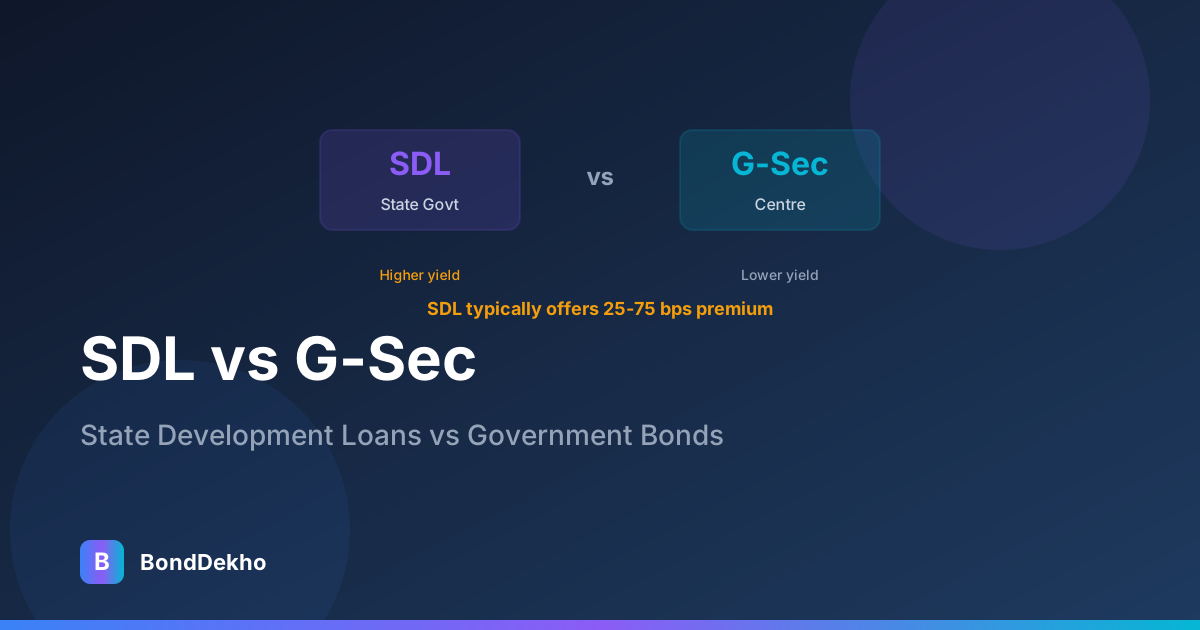
Quick answer: State Development Loans (SDLs) and central G-Secs are both sovereign rupee debt auctioned by the RBI, settled T+1, and taxed identically — interest at slab rate, LTCG at 12.5% after 12 months for listed instruments. SDLs typically yield 25–75 bps more than comparable-tenor G-Secs. That spread reflects state-level credit perception, thinner secondary-market liquidity (wider bid-ask on SDLs), and a structural demand asymmetry favouring Centre G-Secs through the SLR pipeline. No Indian state has formally defaulted on an SDL since 1949. Retail investors can access both through RBI Retail Direct at a ₹10,000 minimum.
You're scrolling through the BondDekho compare page, filtering for sovereign-rated debt, and you notice something odd: two bonds with nearly identical tenors and identical credit ratings — both labelled "sovereign" — but one yields noticeably more than the other. The cheaper one is a central government G-Sec. The pricier yield belongs to an SDL, a State Development Loan issued by a state government.
The natural question: why the gap? Are SDLs riskier? Is there a catch? Are they harder to buy, hold, or exit in a pinch?
Both instruments are legally sovereign debt, both are auctioned by the Reserve Bank of India, and both settle through the same clearing infrastructure. But the differences — in issuer, liquidity, secondary-market depth, and the perception of credit — are real and worth understanding before you allocate.
This post compares SDLs and G-Secs side by side across yields, credit framing, liquidity, tax treatment, and how retail investors can access each.
Key Takeaways
- SDLs are sovereign debt issued by state governments — not the central government, but auctioned by RBI on their behalf, making their legal standing distinct from Centre-issued G-Secs.
- Both SDLs and G-Secs are held in demat — same plumbing as equity shares; same NSDL/CDSL infrastructure, so the custody experience is identical.
- SDLs typically yield 25–75 bps more than comparable-tenor G-Secs — the spread reflects a liquidity and perception premium, not a history of defaults.
- No Indian state has formally defaulted on an SDL post-1949 — but "sovereign" here means state government, not the Centre, so the credit framing is meaningfully different.
- Tax treatment is identical — interest is taxed at your slab rate; listed SDL and G-Sec gains are treated as LTCG after a 12-month holding period.
- G-Secs are far more liquid — secondary-market exit is easier and tighter-spread on G-Secs than on most SDLs, where bid-ask spreads can widen significantly.
- Retail investors can buy both via RBI Retail Direct — SDLs also appear occasionally on OBPPs, though availability varies by platform and auction cycle.
- SDL auctions happen weekly, like G-Sec auctions — states notify the RBI each week, so new SDL issuances are regular rather than sporadic.
What Is an SDL?
A State Development Loan is a market borrowing of an Indian state government, issued to fund the state's fiscal deficit and capital expenditure programmes. Functionally, it's a long-tenor bond: a state government commits to pay a fixed coupon for a defined number of years and return the principal at maturity.
The auctioneer is not the state itself — it is the Reserve Bank of India, acting as banker to the states under the Reserve Bank of India Act, 1934. RBI runs the auctions, settles the trades, and maintains the registry. Borrowing limits for each state are governed by the Fiscal Responsibility and Budget Management (FRBM) framework and the guidance of successive Finance Commissions, which cap how much a state can issue in a given year.
Most SDLs carry tenors between 5 and 30 years, with the bulk of recent issuances clustered around 10–15 years. A typical instrument might be labelled something like "Maharashtra 7.45% 2034" — meaning the state of Maharashtra pays a 7.45% coupon and redeems the principal in 2034. SDLs are fully dematerialised, settle on T+1 alongside Centre G-Secs, and trade on the same NDS-OM platform that hosts Centre debt.
In the sovereign debt hierarchy, SDLs sit one notch below central G-Secs: still sovereign, still backed by tax-raising powers, but state-level rather than Centre-level.
What Is a G-Sec?
A Government Security is a debt instrument issued by the Government of India to finance Centre-level fiscal needs. The G-Sec family contains three main flavours:
- Dated G-Secs — fixed-coupon bonds with tenors of 1 to 40 years. The benchmark 10-year G-Sec is the most actively traded fixed-income instrument in India.
- Treasury Bills (T-Bills) — short-tenor zero-coupon paper, issued at a discount and redeemed at par. Standard tenors are 91, 182, and 364 days.
- STRIPS — separately traded interest-and-principal components of dated G-Secs. Niche, mostly held by institutions.
Like SDLs, all G-Secs are auctioned by the RBI, held in demat at NSDL/CDSL, and settle on T+1. The defining contrast with corporate debt is credit: G-Secs are backed by the Centre's sovereign credit and are conventionally treated as the risk-free benchmark for rupee fixed income — see NCDs vs Government Bonds for that comparison. Retail investors can buy G-Secs primarily through RBI Retail Direct — see the RBI Retail Direct guide for the account-opening flow.
SDL vs G-Sec: The Side-by-Side
The two instruments share the same auctioneer, the same custody pipes, and the same tax treatment. The differences live in three places: the issuer, the secondary-market liquidity, and the structural demand picture. Here's the full comparison:
| Dimension | SDL | G-Sec |
|---|---|---|
| Issuer | State government | Government of India |
| Auctioned by | RBI | RBI |
| Credit risk | Sovereign (state) | Sovereign (Centre) |
| Yield | Typically 25–75 bps higher than comparable G-Sec | Lowest sovereign yield benchmark |
| Liquidity | Lower; thinner secondary market, wider bid-ask | Higher; benchmark G-Secs trade actively |
| Auction frequency | Roughly weekly (states notify RBI weekly) | Weekly |
| Minimum investment | ₹10,000 (RBI Retail Direct) | ₹10,000 (RBI Retail Direct) |
| Tenor range | Typically 5–30 years | Up to 40 years; T-Bills as short as 91 days |
| Tax treatment | Interest at slab; LTCG after 12 months for listed | Interest at slab; LTCG after 12 months for listed |
| Where retail can buy | RBI Retail Direct, NSE goBID, occasionally OBPPs | RBI Retail Direct, NSE goBID, OBPPs |
Why Do SDLs Yield More?
If both instruments are sovereign and both settle through the same plumbing, the yield gap can look puzzling. Three drivers explain most of the spread.
1. State credit perception. Markets do not treat all states identically. A fiscally tighter state with stable own-tax revenue tends to issue at a tighter spread to G-Secs, while a state perceived as fiscally stressed pays more. The "SDL spread" you see quoted in market commentary is usually a weighted average across all states; individual states fan out around it.
2. Liquidity premium. The benchmark 10-year G-Sec trades in volumes that dwarf any individual SDL. When you go to exit before maturity, that depth difference becomes real money: bid-ask spreads on SDLs are routinely several basis points wider than on Centre G-Secs of comparable tenor. Investors demand extra yield up front in exchange for accepting that harder exit.
3. Structural demand asymmetry. Banks must hold a fixed share of their net demand and time liabilities in government securities to meet the Statutory Liquidity Ratio (SLR). SLR-eligible holdings include both Centre G-Secs and SDLs, but the regulatory plumbing has historically biased flows toward Centre G-Secs first, with SDLs absorbing the residual demand. That asymmetry pushes SDL yields a notch higher than they would clear in a perfectly demand-symmetric market.
Spreads are not static. They have compressed meaningfully from peaks above 100 bps in earlier cycles toward the 25–75 bps range more recently, as foreign portfolio flows into Indian sovereign debt have widened the bid for SDLs alongside G-Secs. Treat any specific number you see as a snapshot, not a forecast.
Are SDLs Actually Safe?
The honest answer: SDLs carry no formal default history, but "safe" is doing a lot of work in that sentence. The framing matters more than the slogan.
FRBM constraints. State borrowing is not unbounded. The Fiscal Responsibility and Budget Management framework caps each state's annual fiscal deficit as a percentage of Gross State Domestic Product, and the Centre approves the borrowing calendar. A state that wants to overshoot must negotiate with the Centre — it cannot simply issue more SDLs.
RBI's backstop. The RBI provides a short-term liquidity facility called Ways and Means Advances (WMA) to states whose cash flow runs ahead of receipts. WMA is not a bailout — it has limits and must be repaid quickly — but it has historically smoothed enough state-level cash crunches that no SDL has gone into formal default since 1949.
The honest framing. That clean default record does not mean SDL credit is identical to Centre G-Sec credit. State fiscal stress shows up in market spreads, not in defaults. A state running a structural deficit, depending heavily on Centre transfers, or carrying high contingent liabilities will see its SDLs price wider than a state with strong own-tax revenue. The credit hierarchy implied by credit ratings compresses near the sovereign top, but it does not collapse to a single point.
In short: SDLs are sovereign and have never formally defaulted. They are not Centre G-Secs.
How Do You Buy SDLs vs G-Secs?
For retail investors, the access routes are similar but not identical.
RBI Retail Direct. The cleanest route for both instruments. A single account opened with the RBI lets you bid in primary auctions for Centre G-Secs, T-Bills, SDLs, and Sovereign Gold Bonds, and to buy or sell in the secondary market. Minimum ticket is ₹10,000. The full account-opening flow and bidding mechanics are covered in the RBI Retail Direct guide.
NSE goBID and BSE Direct. Stock exchange platforms that aggregate retail bids and submit them in non-competitive segments of RBI auctions. Useful if you already have a broker login and prefer that flow over a separate Retail Direct account.
OBPPs (Online Bond Platform Providers). Centre G-Secs are routinely listed on most OBPPs in their secondary-market inventory. SDLs appear less consistently — some OBPPs list them when an attractive secondary-market opportunity arises, but availability varies by platform and by auction cycle. Don't expect SDL inventory to be as deep as G-Sec inventory on any given day.
Both instruments are dematerialised, settle on T+1, and require a demat account at NSDL or CDSL — the bond settlement guide walks through that timing in detail.
When Should You Pick SDL Over G-Sec?
There is no universal answer; the right choice depends on what you value most. Three trade-offs help structure the decision.
If extra yield matters more than easy exit. SDLs typically clear 25–75 bps above comparable-tenor G-Secs. If your plan is to hold to maturity, that spread compounds into a meaningful pickup. The cost is liquidity: exiting before maturity is harder and the bid-ask penalty on SDLs is real. Investors who view bonds as buy-and-hold income instruments tend to find SDLs more attractive than investors who treat fixed income as a tradeable allocation.
If you may need to exit early. Centre G-Secs trade in deep markets with tight bid-ask spreads. If your time horizon is uncertain — perhaps the bond is parking capital for a goal whose timing might shift — the easier exit on G-Secs may be worth the lower yield. The trade-off cuts more sharply at long tenors; see exiting a bond before maturity for the mechanics.
If you are new to sovereign debt. Centre G-Secs are the conventional starting point: deepest market, simplest credit story, widest research coverage. Building familiarity with G-Secs first and then considering SDLs as a yield-pickup overlay is one common sequencing.
These are trade-offs, not recommendations. Your own goals, holding horizon, and tolerance for illiquidity should drive the call — and a SEBI-registered adviser can help with portfolio-level allocation.
Common Mistakes Beginners Make
- Treating "sovereign" as zero-risk. Near-zero is not zero. Sovereign bonds carry interest-rate risk that bites when yields move against you, and SDLs additionally carry the state-level fiscal stress that shows up in market spreads even when defaults stay at zero.
- Ignoring liquidity on long-tenor SDLs. A 25-year SDL can be hard to exit in any meaningful size. If your horizon is uncertain, the spread you earn matters less than the haircut you may take to get out.
- Confusing SDLs with PSU bonds. SDLs are state-issued sovereign debt. PSU bonds are corporate debt issued by public-sector companies — different credit, different tax, different rating logic. The "PSU" label can blur the line; check the issuer name, not the badge.
- Buying without checking residual tenor. A "10-year SDL" issued seven years ago has three years left. The tenor that matters for your portfolio is the residual tenor at the time of purchase, not the original tenor at issuance.
SDL vs G-Sec: Frequently Asked Questions
Are SDLs safer than corporate bonds?
SDLs are sovereign debt and carry no formal default history since 1949. Corporate bonds — even those rated AAA — have default and downgrade history, and their credit risk is a genuine, distinct factor from interest-rate risk. The trade-off is yield: corporate AAAs typically yield more than SDLs of similar tenor.
Can a state government default on an SDL?
No formal default has occurred since 1949. RBI's Ways and Means Advances facility provides a short-term backstop for state cash flow mismatches. Spreads vs Centre G-Secs reflect market-perceived state-level fiscal stress, not realised default events.
What's the typical tenor of an SDL?
Most SDLs are auctioned with tenors between 5 and 30 years, with recent issuances clustered around 10–15 years. A handful of states have issued longer-dated paper. Always check residual tenor — the years left until maturity at the time you buy — rather than the original issued tenor.
Are SDLs taxed differently from G-Secs?
No. Both are taxed identically: interest income at your applicable income-tax slab rate; long-term capital gains treatment after 12 months for listed instruments held in demat. There is no special concessional rate for either.
How do I buy an SDL as a retail investor?
The simplest route is RBI Retail Direct — the same account that lets you buy G-Secs and Sovereign Gold Bonds. NSE goBID and BSE Direct support primary auctions through brokers. Some OBPPs occasionally list SDLs in their secondary-market inventory. The minimum investment via RBI Retail Direct is ₹10,000.
Why do SDLs yield more than G-Secs of similar tenor?
Three drivers: state credit perception, lower secondary-market liquidity, and a structural demand asymmetry that benefits Centre G-Secs through the SLR pipeline. The combined effect typically lands SDLs in a 25–75 bps premium range over comparable-tenor Centre G-Secs.
Bottom Line
SDLs and G-Secs are both sovereign rupee debt, settled through the same demat infrastructure and taxed identically. SDLs are issued by states and trade at a 25–75 bps yield premium that compensates investors for thinner secondary-market liquidity and a credit story that, while clean on default history, sits one notch below the Centre. G-Secs offer the deepest market and the simplest credit story; SDLs offer extra yield to investors comfortable holding to maturity. The right choice depends on your goal, your holding horizon, and how much liquidity you want to keep in reserve.
Disclaimer: This post is for educational purposes only. BondDekho is not a SEBI-registered investment adviser. Yields and risks mentioned are illustrative; consult a SEBI-registered adviser before making any investment decision.